
Multifamily Technical
Sustainable Flooring & LEED for Multifamily
How low-emission flooring, recycled content, and Environmental Product Declarations earn LEED and green-building credits on multifamily projects — and exactly which documents your reporting team needs to pull.
Multifamily Technical · 11 min read
Sustainability language shows up in almost every multifamily spec book now, and flooring is one of the line items that gets scrutinized because it covers so much surface area and sits so close to the people who breathe the air inside a unit. For a developer or apartment operator in the Treasure Valley, "green flooring" is rarely about a warm feeling. It is about a certification target, a lender requirement, a marketing claim you can defend, or a set of documents that has to survive an auditor's review two years after the ribbon is cut. That is a different problem than picking a good-looking plank, and it is worth understanding before the flooring package is bid.
The honest version of the story is this: flooring by itself will not certify a building. What flooring does is contribute points and satisfy prerequisites inside a larger scorecard, and it does so almost entirely through paperwork — emission certificates, content declarations, and manufacturer-issued environmental reports. The physical product matters, but on a certifying project the documentation is the deliverable. If the paper is missing, the credit is missing, no matter how genuinely low-emitting or recycled the material happens to be. This guide walks through what those documents are, which credits flooring can actually reach, and how to make sure the trail is intact from submittal through closeout.
Everything below applies whether you are chasing formal LEED certification, a lender's green-building overlay, an Idaho energy program, or simply a corporate ESG report you have to stand behind. The mechanics are the same. Alderwood Flooring is an Idaho Registered Contractor (Idaho RCE-6681702), insured, and we plan flooring scopes with these reporting requirements in mind from the submittal stage forward.
Indoor air quality is the credit flooring reaches most reliably
The single most dependable way flooring earns green-building credit is through low chemical emissions, specifically volatile organic compounds. Adhesives, finishes, backings, and the flooring itself off-gas VOCs, and in a tight, well-sealed multifamily envelope those compounds accumulate in the breathing zone. The U.S. EPA has documented that indoor air is frequently more polluted than outdoor air, and flooring is one of the larger interior surfaces a resident is exposed to around the clock. That is why nearly every rating system treats low-emitting materials as a distinct, achievable credit.
For hard surface flooring — luxury vinyl, laminate, engineered wood, tile, resilient sheet — the recognized emissions certification is FloorScore, administered by SCS Global Services in partnership with the Resilient Floor Covering Institute (RFCI). A FloorScore certificate means the product was tested against the California Section 01350 emission criteria (the CDPH v1.2 standard method) and passed. When a spec calls for "low-emitting materials," a current FloorScore certificate is usually the cleanest way to satisfy it for the flooring category. Ask for the certificate by product SKU and confirm the expiration date, because certificates lapse and a two-year-old PDF may no longer be valid at the time of your audit.
FloorScore, CARB Phase 2, and the difference between them
These two get conflated constantly, and confusing them will cost you at submittal review. FloorScore certifies total VOC emissions from the finished flooring product into indoor air. CARB Phase 2 is narrower: it is the California Air Resources Board limit on formaldehyde emissions from composite wood cores — the fiberboard or particleboard substrate inside laminate and many engineered products. CARB Phase 2 was effectively adopted nationally through the EPA's TSCA Title VI rule, so compliant product is the market default now, but the label still matters to auditors.
Practically, a certifying multifamily project wants both. You want CARB Phase 2 / TSCA Title VI compliance to prove the wood core is not a formaldehyde source, and you want FloorScore to prove the assembled product meets the broader indoor-air emission thresholds. For a fuller look at how these attributes sit alongside wear-layer and durability specs on the products we most often install in apartments, our LVT durability specification guide breaks down what to demand on the cut sheet. Get both attributes onto the submittal in writing rather than trusting a salesperson's verbal assurance.
Recycled content and where the numbers actually come from
Recycled content is a real credit lever, but it is also where marketing gets loose, so treat the claims skeptically. Rating systems generally count recycled content by weight and distinguish post-consumer material (diverted from a consumer waste stream) from pre-consumer or post-industrial material (manufacturing scrap reintroduced before it ever reached a customer). Post-consumer content is weighted more heavily because it represents genuine diversion.
Different flooring types carry very different recycled stories. Some resilient and rubber floorings incorporate meaningful recycled polymer or reclaimed tire content. Carpet tile is often the strongest performer, with take-back programs and high recycled backing percentages. Ceramic and porcelain tile can contain recycled glass or fired scrap. Solid and engineered wood generally do not compete on recycled content — their environmental case rests on renewability, responsible forestry sourcing, and longevity instead. When a manufacturer states a recycled percentage, ask for it in a signed letter or on a Health Product Declaration or EPD, with the post-consumer and pre-consumer split broken out. A round number in a brochure is not documentation an auditor will accept.
Environmental Product Declarations and the transparency credits
The transparency credits are where a lot of multifamily projects now find their easiest points, and flooring participates directly. An Environmental Product Declaration, or EPD, is a standardized, third-party-verified report of a product's environmental impacts across its life cycle — think of it as a nutrition label for embodied carbon and resource use, built on an underlying life cycle assessment and a published product category rule. LEED and similar systems award points simply for specifying a threshold number of permanently installed products that carry EPDs, regardless of whether one product's footprint is lower than another's. You are being rewarded for transparency, for choosing manufacturers who did the disclosure work.
There are two flavors worth knowing. An industry-wide (generic) EPD covers a product category broadly; a product-specific (manufacturer) EPD covers one company's actual product and counts more heavily in most scorecards. Alongside EPDs sit Health Product Declarations (HPDs), which disclose the chemical ingredients and any hazards rather than the carbon impacts — a separate material-ingredients credit that flooring can also feed. When you build the flooring submittal, collect the EPD, the HPD, the FloorScore certificate, and the CARB Phase 2 statement as a single packet per product. That packet is what makes a floor "certifiable" on paper.
Which LEED and green-building credits flooring can touch
To set expectations honestly: on a typical LEED for multifamily project, flooring most commonly contributes to the Indoor Environmental Quality low-emitting materials credit, the Materials & Resources building product disclosure and optimization credits (the EPD credit, the sourcing/recycled-content credit, and the material-ingredients credit), and occasionally an innovation or regional-materials angle if the product is manufactured within the qualifying radius. Flooring does not by itself reach energy, water, or site credits. Anyone telling you a floor "gets you LEED" is overselling. What it does is chip in several attainable points across those two categories, and on a tight scorecard those points are often the difference between certification tiers.
Related standards frequently appear in the same spec section and are worth recognizing even though they are not sustainability credits: ASTM E492 and ASTM E90 govern the acoustic (impact and airborne sound) testing that multifamily assemblies must meet, and ANSI A326.3 dynamic coefficient of friction ratings govern slip resistance in common areas. Green intent and code compliance ride together in the flooring submittal, so plan to satisfy both at once. Our multifamily flooring overview covers how acoustic and durability requirements interact with the sustainability package on apartment builds.
Pulling the documentation a reporting building actually needs
Here is the workflow that keeps a certifying project out of trouble. First, at design, write the required attributes into the flooring spec explicitly — FloorScore, CARB Phase 2, product-specific EPD, HPD, and any recycled-content minimum — rather than a vague "shall be sustainable." Second, at submittal, require the installing contractor to return the actual certificates and declarations keyed to the exact SKUs being furnished, and verify the certificates are current. Third, and this is the step most often missed, hold the adhesives and underlayments to the same standard. A FloorScore-certified plank installed over a high-VOC glue can blow the low-emitting credit, because the assembly is what emits into the unit. Specify the trowel-applied adhesive and any acoustic underlayment with their own emission documentation.
Fourth, at closeout, assemble a flooring sustainability binder — one PDF per product line containing the certificate set, plus the adhesive documentation, plus mill certificates for recycled content. That binder is what the certification reviewer or an ESG auditor opens. Building it during construction, while the data is fresh and the reps are responsive, is trivial. Reconstructing it eighteen months later, after SKUs have changed and certificates have expired, can be nearly impossible. Treat the paperwork as a construction deliverable with its own schedule, not an afterthought.
Making it work in Treasure Valley conditions
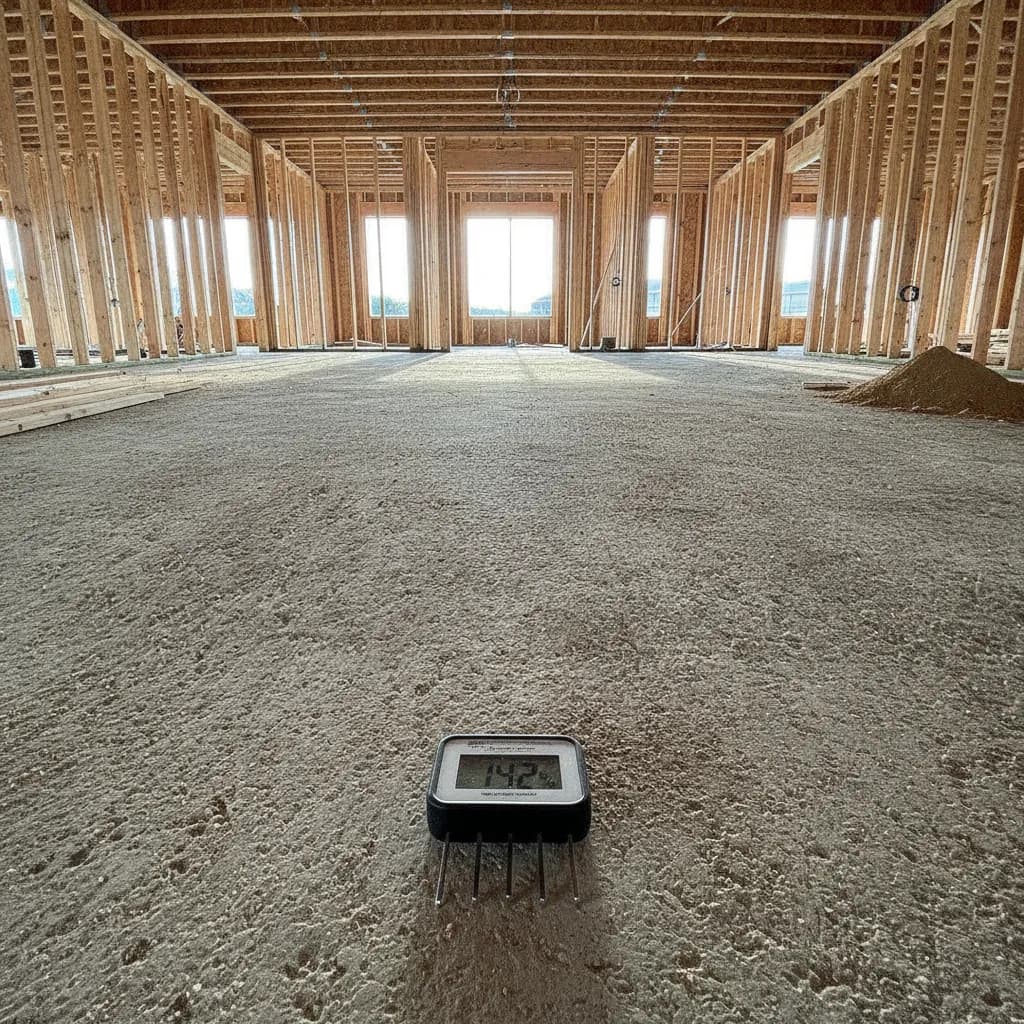
Sustainability targets do not suspend building physics, and Idaho's high-desert climate imposes its own constraints on which green products actually perform. Winter indoor humidity here routinely drops into the teens under forced-air heat, which drives wood movement — so an engineered or wood product chosen for its EPD still has to be acclimated and gapped for a dry-winter, humid-summer swing, or the sustainability story ends in cupping and callbacks. Slab-on-grade multifamily construction across the valley demands moisture testing under ASTM F2170 (in-situ relative humidity) or ASTM F1869 (calcium chloride) before any resilient or wood floor goes down, because a low-emitting floor over a wet slab still fails. Ground-floor and mudroom-adjacent units that take snow, gravel, and grit need a wear layer specified for abrasion regardless of its green credentials.
The right way to hit a certification target in this market is to select products that satisfy both the documentation and the climate at once — then install them to the conditions the units will actually see. On the developer and multifamily resources side of our practice, we plan flooring packages with the certification paperwork and the Idaho performance realities treated as one problem rather than two. If you are targeting LEED, a lender's green overlay, or an ESG report on a Treasure Valley multifamily project, reach out to Alderwood Flooring through our contact form with your rating system and your product shortlist, and we will help you assemble a flooring scope whose documentation holds up.
Sources & Further Reading
Explore related
Ready for Floors You'll Love?
Ready to talk through your project? Free estimates throughout The Treasure Valley & Boise Metro.