
Multifamily Technical
Low-Emission Flooring: CARB Phase 2 & TSCA Title VI
What CARB Phase 2 and EPA TSCA Title VI actually require of composite-wood flooring, how FloorScore certification works, and why formaldehyde control matters most in tight, winter-sealed Idaho apartments. A practical guide to specifying and documenting low-emission floors.
Multifamily Technical · 10 min read
Most flooring specifications for multifamily projects spend pages on wear layers, slip resistance, and warranty terms, then treat indoor air quality as an afterthought handled by a single line item: "low-VOC." That gap has consequences. In a Treasure Valley apartment sealed against a January cold snap, with the forced-air furnace recirculating the same interior air for weeks, the chemistry of what you glued and clicked into the floor matters more than the marketing on the box. Formaldehyde off-gassing from the composite-wood cores under engineered wood and rigid-core LVT is real, it is regulated, and the paperwork proving compliance is something a green-reporting building will be asked to produce.
The good news is that the regulatory floor is now high. Since the federal EPA TSCA Title VI standard took full effect, essentially all composite wood sold or used in the United States has to meet the same formaldehyde emission limits that California's CARB program pioneered. The bad news is that "compliant" is a minimum, not a guarantee of good indoor air, and it is easy to specify a product that technically meets the law while leaving performance and documentation gaps that surface during commissioning or a resident complaint. This guide explains what CARB Phase 2 and TSCA Title VI actually require, how FloorScore certification layers on top, why the Idaho climate raises the stakes, and how to collect the product documentation your project team and any green-building consultant will need.
What formaldehyde is doing in a floor assembly
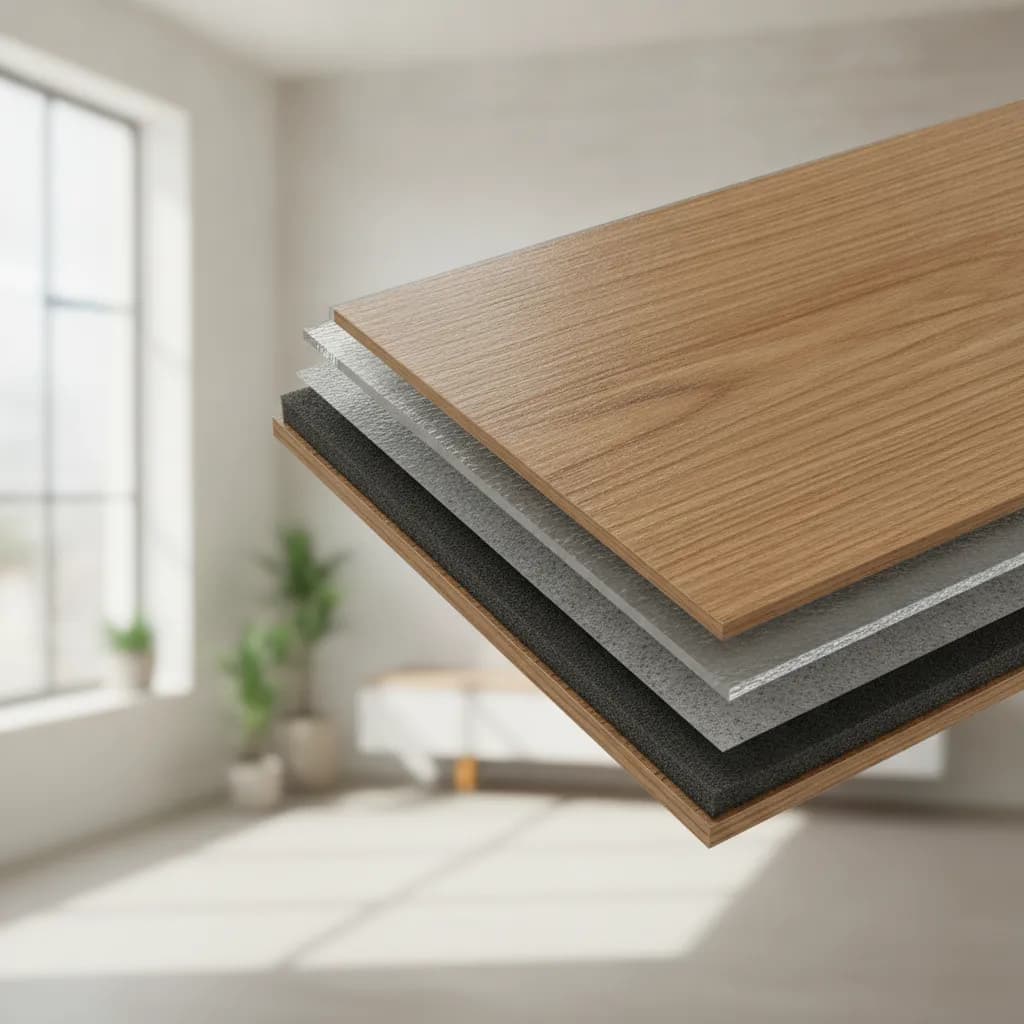
Formaldehyde is not an additive someone chooses to put in flooring. It is a byproduct of the resins that bind wood particles and veneers together. Urea-formaldehyde (UF) resins are inexpensive and strong, and they historically dominated the cores of engineered wood, plywood substrates, particleboard, and medium-density fiberboard (MDF) used under decorative surfaces. Those resins continue to release small amounts of formaldehyde gas over the life of the product, with emission rates that rise as temperature and humidity climb. In flooring, the exposure pathway is the core layer of an engineered plank, the HDF core of a laminate, and the substrate beneath some rigid-core LVT products. Solid sawn hardwood and pure stone-plastic composite cores contain no formaldehyde-based binder at all, which is one reason material selection is the first lever, not the last.
Formaldehyde matters because it is a known respiratory irritant and a recognized carcinogen, and because people in apartments spend a large share of their time indoors, close to the floor. The EPA's guidance on indoor air quality makes the general point that concentrations of many pollutants run substantially higher indoors than outdoors, and that ventilation, source control, and material choice are the practical controls a building operator actually holds.
What CARB Phase 2 and TSCA Title VI actually require
The California Air Resources Board (CARB) wrote the original Airborne Toxic Control Measure for composite wood products, phasing in two tiers of emission limits. CARB Phase 2, the stricter tier, set the numbers the industry now treats as the baseline: roughly 0.05 parts per million (ppm) for hardwood plywood, 0.09 ppm for particleboard, and 0.11 ppm for MDF, measured by defined chamber tests. The EPA then adopted these same limits nationally under Title VI of the Toxic Substances Control Act. In practice, the federal TSCA Title VI formaldehyde standard and CARB Phase 2 are harmonized: a panel certified to one is generally certified to both, and finished goods sold in the United States must carry a compliance label identifying the panel producer and a third-party certifier (a TSCA Title VI TPC).
Two categories sit above the baseline and are worth specifying by name. ULEF stands for Ultra-Low-Emitting Formaldehyde, a designation for resins that emit so little that the certifier reduces required testing frequency. NAF stands for No-Added Formaldehyde, meaning the binder chemistry contains no added urea-formaldehyde at all; soy-based, polyvinyl acetate, and MDI (methylene diphenyl diisocyanate) resins are common NAF routes. For a multifamily project where indoor air is a genuine concern, writing "composite-wood components shall be CARB Phase 2 / TSCA Title VI compliant, ULEF or NAF preferred" moves you from the legal minimum toward the low end of actual emissions. The relevant chamber and quality-control test methods are defined under ANSI, including the ANSI A208 panel standards and ASTM chamber methods, and the compliance label should reference them.
FloorScore: the certification that speaks flooring's language
CARB and TSCA regulate the wood panel. They do not certify the finished floor as a whole, and they do not address the adhesives, backings, and surface coatings that also emit volatile organic compounds. FloorScore fills that gap. Administered by SCS Global Services in partnership with the Resilient Floor Covering Institute (RFCI), FloorScore indoor air quality certification tests the complete flooring product against the California Department of Public Health Standard Method v1.2 (commonly called CDPH or "Section 01350"). That protocol places the product in an environmental chamber and models a real occupied space, then checks measured concentrations of formaldehyde and a long list of individual VOCs against health-based limits.
For a specifier, FloorScore is the single most useful line to require, because it evaluates the product a resident actually stands on rather than one component inside it. It is recognized by the major green-building frameworks as a compliant path for low-emitting materials credits, which matters if the project is pursuing a certification or an ESG report. When a product carries both a TSCA Title VI compliance label on its core and a current FloorScore certificate on the finished good, you have covered both the regulated panel and the assembled floor. Ask for the certificate number and expiration date, not just a logo on a cut sheet.
Why sealed Idaho winters raise the stakes
Formaldehyde emission is not a fixed number; it climbs with temperature and relative humidity, and indoor concentration depends on how much fresh air dilutes it. Treasure Valley winters create a difficult combination. Units are sealed tight against outdoor temperatures that sit below freezing for weeks. Forced-air furnaces recirculate interior air, and in a well-weatherized new apartment the air-change rate can be low unless mechanical ventilation is deliberately designed and running. That is precisely the condition under which a low-level emitting source accumulates rather than dissipating.
High-desert dryness pulls in the opposite direction on emission rate but introduces its own problem: wood movement. Winter indoor relative humidity in a heated Idaho unit can fall into the teens, well below the 30 to 50 percent range the National Wood Flooring Association (NWFA) identifies as the service window for wood flooring. Dry cores shrink and gap, which is a performance issue, and the humidification systems owners add to fix gapping can raise emission rates if the building overshoots. The practical takeaway is that in Idaho multifamily you are managing air quality and dimensional stability at the same time, and both point toward NAF or ULEF cores plus disciplined humidity control in the 30 to 45 percent range. These are the same movement dynamics that shape any wood or rigid-core selection, and they are worth reviewing alongside the wear-and-tear tradeoffs covered in our LVT durability specifications for developers.
Choosing the assembly, not just the plank
Source control is the most reliable air-quality strategy, so material selection does most of the work. Solid and engineered wood with NAF cores, and stone-polymer composite (SPC) rigid-core LVT, both avoid urea-formaldehyde binders in the load-bearing layer. Where a product does use a composite core, ULEF is the meaningful upgrade. But the plank is only part of the assembly. Glue-down installations introduce adhesive VOCs, so specify low-VOC adhesives that themselves carry FloorScore or an equivalent CDPH-tested rating. Underlayments, moisture-mitigation coatings, and any site-applied finish or sealer all add to the total emission load of the finished space, and each should be checked rather than assumed clean.
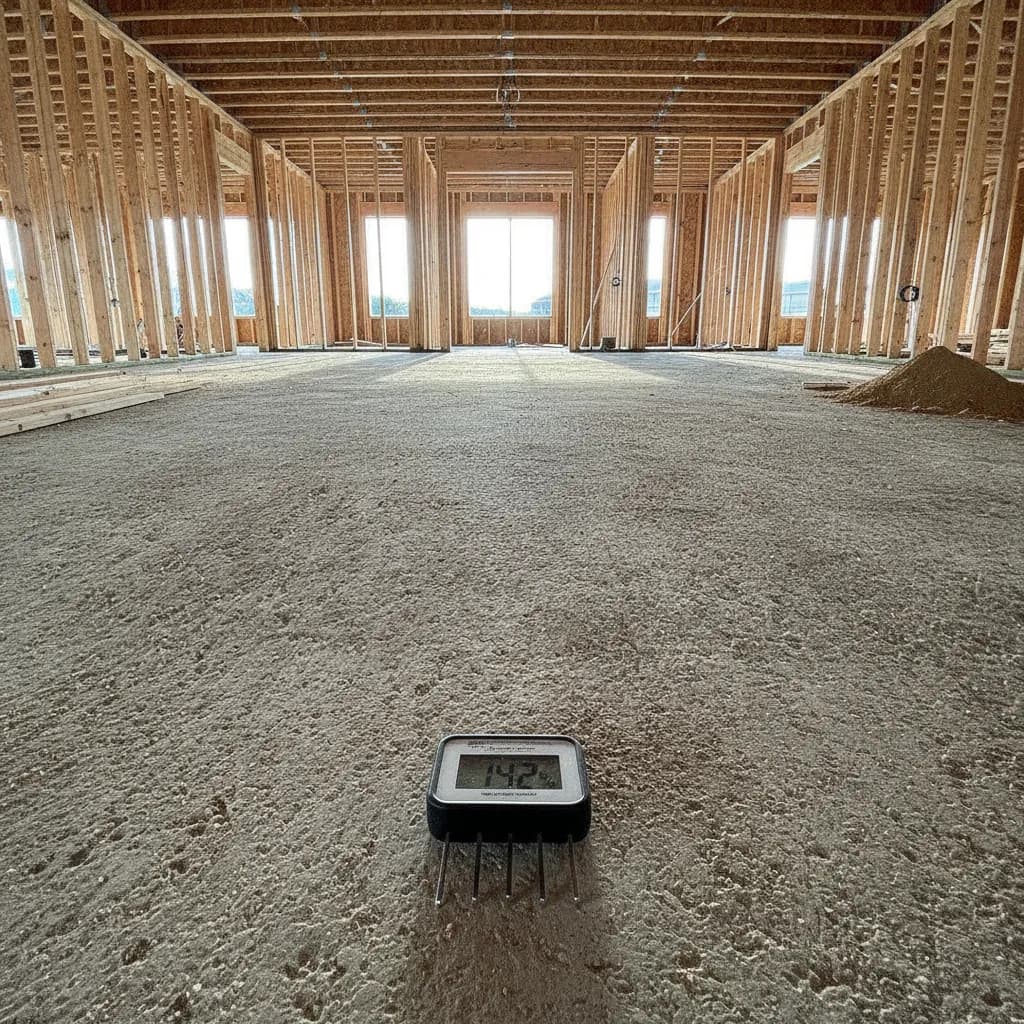
Installation method interacts with the building's moisture profile too. Slab-on-grade construction, common across new Treasure Valley multifamily, requires slab moisture testing before any glue-down or moisture-sensitive assembly. ASTM F2170 (in-situ relative humidity probes) and ASTM F1869 (calcium chloride) are the accepted methods, and excess slab moisture can both fail an adhesive bond and, in some assemblies, elevate emissions and microbial risk. Getting the substrate right protects both durability and air quality, which is why these tests belong in the same submittal package as the emissions documentation. The full picture of specifying resilient floors for rental-grade wear, moisture, and turnover is something we lay out for apartment owners choosing durable rental flooring.
Building the documentation package for a green report
If your project is filing for a green-building certification or an ESG disclosure, the deliverable is paperwork, and it is easier to collect it during specification than to reconstruct it after installation. For each flooring product, assemble four things: the manufacturer's TSCA Title VI / CARB Phase 2 compliance statement identifying the panel producer and third-party certifier; the current FloorScore certificate with number and expiration; the CDPH v1.2 test summary or emissions data sheet showing formaldehyde and total VOC results; and the adhesive and underlayment documentation with their own low-emitting ratings. Ask whether cores are ULEF or NAF and get it in writing on the product data.
Keep the compliance labels from the shipped material as well. TSCA Title VI requires finished-good labeling that traces back to the certified panel, and a green consultant or an auditor may want to see that the installed lot matches the specified product. Capturing lot information and cut-sheet revisions at delivery avoids a scramble months later. For teams managing this across a portfolio of buildings, standardizing the submittal checklist once and reusing it is far less painful than treating every project as a new research task; we work through that process with owners and developers on our multifamily flooring page.
How Alderwood approaches low-emission multifamily work
Alderwood Flooring is an Idaho Registered Contractor (Idaho RCE-6681702), insured, and staffed by people with 20+ years combined experience specifying and installing resilient and wood flooring in the Treasure Valley. On a low-emission multifamily scope, that means starting from the building's real conditions: slab moisture data, the mechanical ventilation and humidity strategy, and the turnover and wear expectations for the unit type. From there we help narrow to assemblies that meet CARB Phase 2 and TSCA Title VI as a floor and hold up to Idaho's dry winters and gritty mudroom entries, and we assemble the FloorScore and emissions documentation your project team or green consultant will need to close out.
Low-emission flooring is not a premium checkbox; in a sealed, forced-air Idaho apartment it is basic building science, and it is entirely achievable within a normal multifamily budget when the decisions are made early. If you are specifying floors for a new or renovated multifamily project and want the emissions, moisture, and durability questions handled together rather than in separate silos, reach out to Alderwood through our contact form and we will help you build a specification and a documentation package you can stand behind.
Sources & Further Reading
Explore related
Ready for Floors You'll Love?
Ready to talk through your project? Free estimates throughout The Treasure Valley & Boise Metro.