Multifamily Technical
Commercial-Grade LVT Specs for Rentals & Multifamily
A practical guide to reading LVT specs for rental duty: wear-layer mils, SPC vs WPC cores, ASTM F1700 and F3261 classifications, waterproof-core caveats, and how warranties quietly change for multifamily and commercial use.
Multifamily Technical · 10 min read
Most LVT sold today is engineered to survive a single-family living room where two adults walk in socks. Multifamily and rental duty is a different physics problem entirely: turnovers every 12 to 24 months, dragged furniture, dog nails, rolling loads, gravel tracked off a Boise parking lot in February, and a maintenance crew that will damp-mop with whatever is under the sink. When a spec sheet says "waterproof, scratch-resistant, commercial-grade," none of those words are regulated marketing terms. The numbers behind them are. Learning to read those numbers is the difference between a floor that pencils out over a 10-year hold and a floor you rip out at year four because the wear layer polished through in the entry.
This guide walks through how to actually read an LVT specification for rental and multifamily use: what wear-layer thickness in mils really buys you, the difference between residential and commercial wear ratings, how rigid-core constructions (SPC versus WPC) behave differently under load and temperature, what the ASTM F1700 classification on the back of a sample tells you, how "waterproof core" claims should be qualified, and — the part that quietly costs owners the most — how manufacturer warranties change the moment a floor is installed in a rental or commercial setting. The relevant standards here are ASTM F1700 and ASTM F3261, the RFCI (Resilient Floor Covering Institute) test protocols, and FloorScore for indoor air quality. None of them are optional reading if you are buying flooring by the truckload.
Everything below is written for the Treasure Valley: high-desert winter dryness that pulls moisture out of everything, forced-air heat that cycles hard, slab-on-grade construction across most new multifamily, and the fast-growth reality that you are often speccing before the building is dried in. Alderwood Flooring is an Idaho Registered Contractor (Idaho RCE-6681702), and the framing here is capability-focused: what to consider and how the work is done, not a sales pitch.
Wear Layer in Mils Is the First Number That Matters
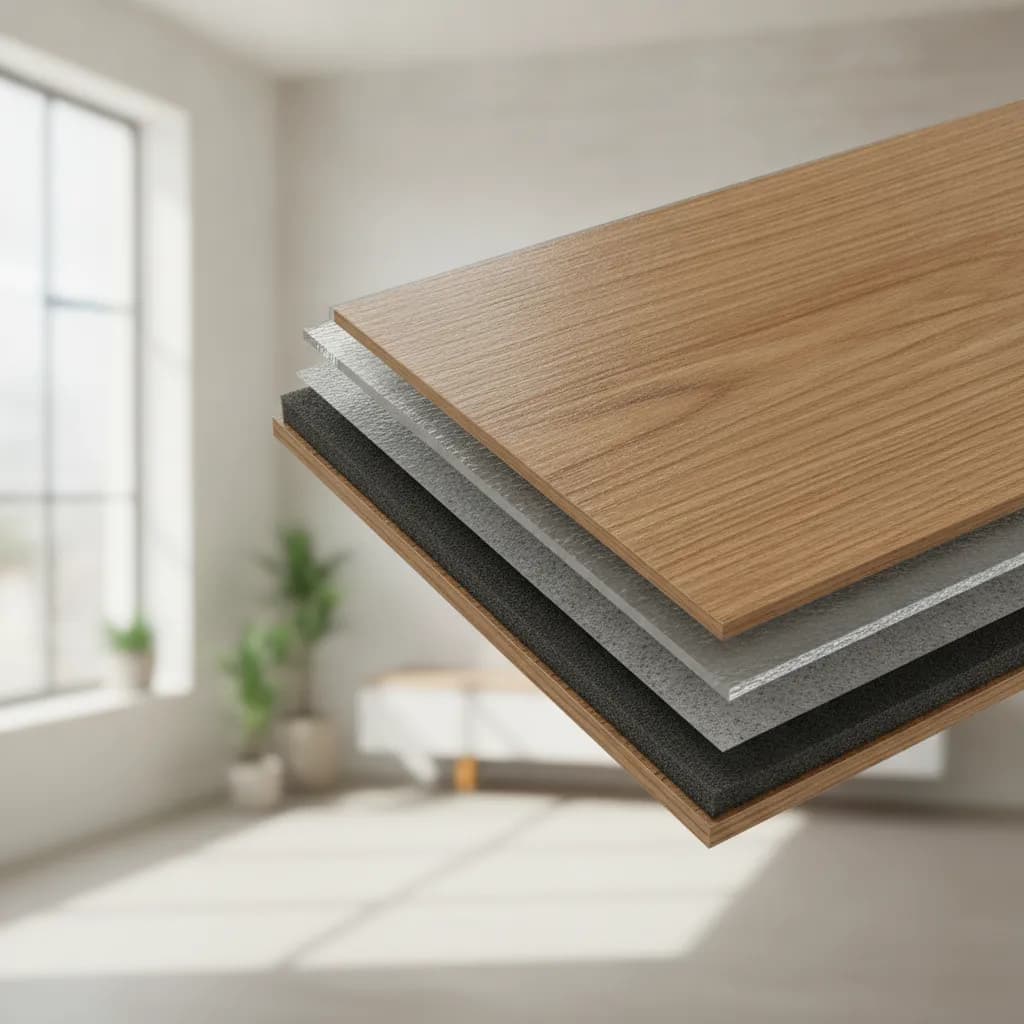
The wear layer is the clear, printless top layer of PVC that sits above the printed film. It is the sacrificial surface — every scratch, scuff, and abrasion event spends down that thickness. It is measured in mils, where 1 mil equals one-thousandth of an inch (0.001"). This is the single most predictive spec for how a rental floor ages, and it is also the one buyers most often misread because samples list it in the fine print.
Rough working tiers: 6 mil and 8 mil are residential grades — fine for an owner-occupied home, thin for a rental. 12 mil is the practical floor for rental and light-commercial apartment interiors. 20 mil (and up) is genuine commercial wear layer, appropriate for corridors, clubhouses, leasing offices, and any Class A property where you want one installation to outlast several tenancies. The jump from 12 to 20 mil is not linear in cost, but it is close to linear in service life for high-traffic paths.
Do not confuse wear layer with overall plank thickness. A 5 mm plank can carry a 12 mil or a 22 mil wear layer — the rest of that 5 mm is core and backing, which govern stability and feel, not abrasion resistance. When a rep quotes "6.5 mm thick," ask the follow-up: how many mils on top. If they cannot answer from the cut sheet, treat the product as unspecified.
Residential vs Commercial Wear Ratings, and What ASTM F1700 Actually Says
ASTM F1700 is the Standard Specification for Solid Vinyl Floor Tile — the classification system printed on many LVT cut sheets. It sorts product into Classes by wear-surface construction (for example, Class III is printed film with a wear layer, which covers most decorative LVT), and it specifies performance requirements the product must meet: residual indentation, dimensional stability, resistance to chemicals, and more. When a spec sheet cites "meets ASTM F1700, Class III," that is a real, testable claim, not a marketing adjective.
For rigid-core and floating LVT specifically, the newer standard is ASTM F3261 — the Standard Specification for Resilient Flooring in Modular Format with Rigid Polymeric Core. Most SPC and WPC "click" planks you are speccing for multifamily are governed by F3261, not the older glue-down-oriented F1700. It sets requirements for core density, dimensional stability under temperature swing, static load, and locking-system integrity. If a product references F3261, you are looking at something engineered and tested as a floating rigid-core system. If a rep cannot tell you which standard the product is tested to, that is your answer about how seriously the product was engineered.
Layered on top of these is the RFCI, the trade body behind the test protocols and the certification programs the resilient industry actually uses. RFCI standardizes the methods — abrasion, indentation, and the indoor-air-quality testing that feeds FloorScore certification — so that a "commercial" claim from one mill can be compared against another. When you evaluate two products side by side, you are really comparing how each performed against the same RFCI-referenced methods.
SPC vs WPC: Rigid Core Types and How They Behave Under Idaho Conditions
Rigid-core LVT comes in two dominant constructions, and the difference matters more in Idaho than in a mild coastal climate. SPC (stone-plastic composite) uses a dense limestone-and-PVC core. It is harder, thinner, heavier, and dimensionally very stable across temperature swings — the core barely expands or contracts when a forced-air system cycles a slab-on-grade unit from cold morning to warm afternoon. That stability is exactly what you want over a Treasure Valley slab, near west-facing sliders, and in units that sit empty and unconditioned between tenants.
WPC (wood-plastic composite, though the "W" is a foamed polymer, not real wood) uses a lighter, foamed core. It feels warmer and softer underfoot and deadens sound a little better, which reads well in a leasing tour. The trade-off is that a foamed core is more thermally reactive and less resistant to point-load indentation — a refrigerator foot or a stiletto heel leaves a mark more readily. For rental durability I generally steer multifamily interiors toward SPC for its indentation and dimensional performance, reserving WPC for spaces where underfoot comfort is the selling point and loads are light. Whichever you choose, the rigid-core durability specifications for rental duty should be pulled from the cut sheet, not the sales deck.
"Waterproof Core" Is a Real Claim With an Asterisk
SPC and WPC cores are genuinely waterproof — the core itself will not swell when wet, which is the failure mode that destroyed the old laminate-in-apartments experiment. That is true and worth having. But "waterproof floor" and "waterproof core" are not the same statement, and the gap is where owners get burned.
Water still travels through the seams between planks and, on a floating floor, sits on the subfloor underneath. A dishwasher that leaks for a week does not swell the LVT; it grows mold on the slab and pad beneath a floor that looks perfectly fine on top. In a stacked multifamily building that becomes a downstairs-unit ceiling problem. So the waterproof-core claim is real for the plank and incomplete for the assembly. In wet-prone areas — entries off a snowy Boise parking lot, mudrooms, laundry closets, under dishwashers — the mitigation is a glue-down installation or a properly sealed perimeter and transitions, plus a subfloor moisture strategy, not faith in the plank alone.
Slab Moisture and Acclimation: The Idaho Failures Happen Below the Plank
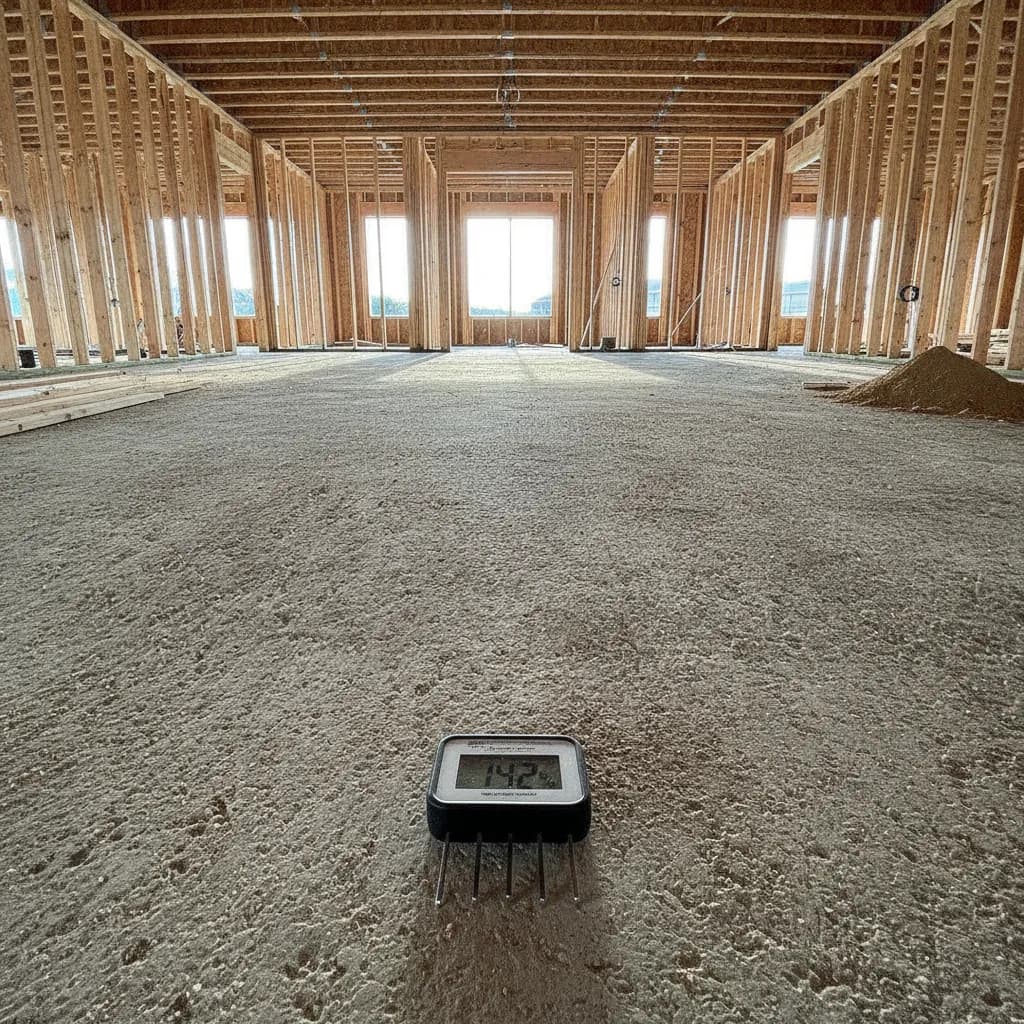
Most rigid-core LVT is marketed as forgiving of subfloor moisture, and relative to wood it is. But new multifamily in the Treasure Valley is overwhelmingly slab-on-grade, and green concrete releases moisture vapor for weeks to months. When you are speccing before the building is dried in, that concrete may not be ready. The right move is to test — ASTM F2170 (in-situ relative humidity probes) and ASTM F1869 (calcium chloride, for moisture vapor emission) give you a number instead of a guess, and manufacturers publish a maximum RH the product and its adhesive can tolerate.
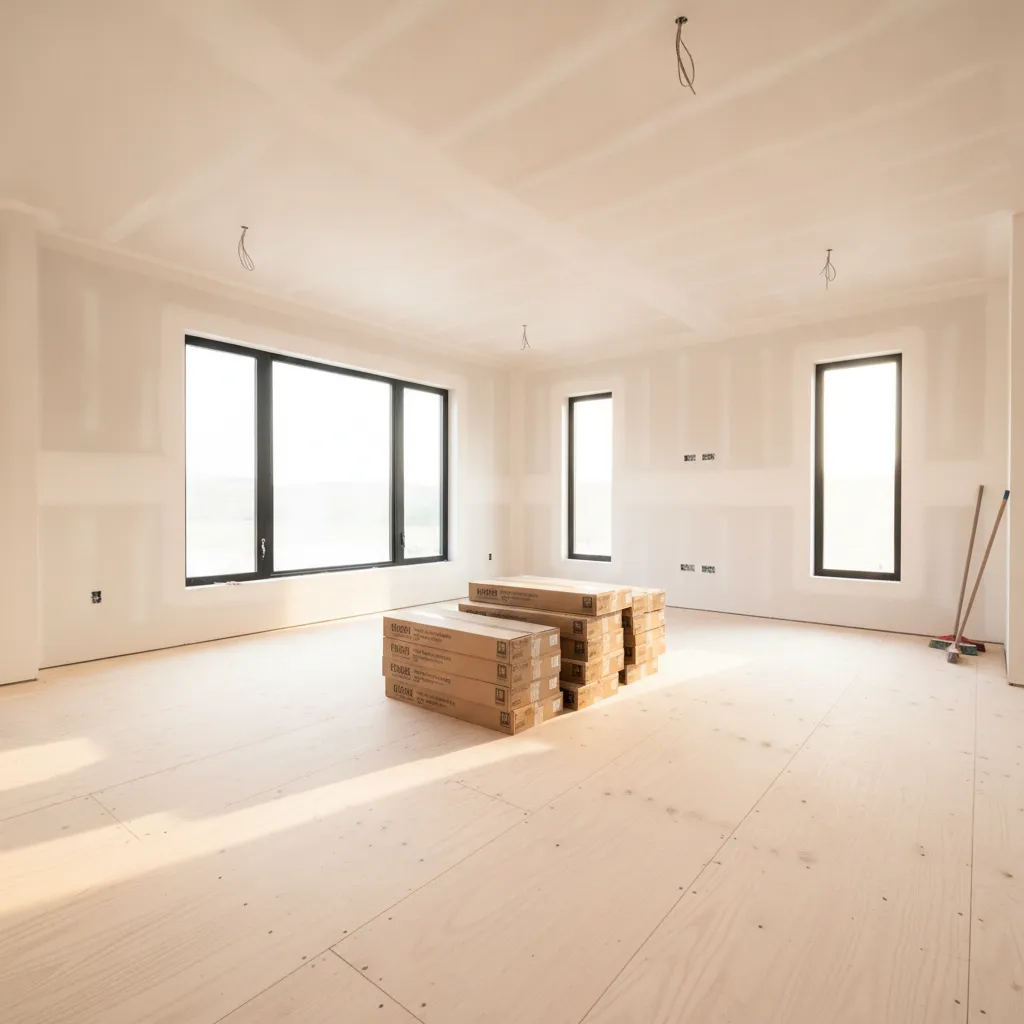
Acclimation is the second silent failure. High-desert interiors run dry, and rigid planks staged in a cold garage then installed into a heated unit will move. Letting product acclimate to the conditioned space it will live in — flat, at service temperature, for the manufacturer's stated window — is a small step that prevents the gapping and edge-peaking that shows up three months after move-in. These are the details that separate a floor that reads well on the luxury vinyl plank options sample board from one that performs after the first winter.
How Warranties Actually Change for Multifamily and Commercial Use
Here is the clause owners skip. A residential LVT warranty — often "lifetime residential" — frequently drops to a much shorter commercial or "light commercial" term the instant the floor goes into a rental or a common area. A lifetime residential product may carry a 5-, 10-, or 15-year commercial warranty, and some residential warranties explicitly exclude multifamily and rental use altogether. If you install a residentially-warranted product in an apartment, you may have no warranty at all.
Read the warranty for three things: the commercial term length, the traffic classification it is warranted to (light, medium, heavy commercial), and the exclusions — which almost always include improper subfloor moisture, indentation from point loads, damage from unrated casters, and failure to acclimate. Match the product's commercial rating to the actual duty of each space; a unit interior, a corridor, and a fitness room are three different traffic classes and may warrant three different specs. Manufacturers also pro-rate: a 15-year commercial warranty rarely pays out at full value in year 12. Underwrite the floor on its commercial term, not the headline residential number.
Indoor Air Quality, DCOF, and the Specs Property Managers Forget
Two more specs belong in any multifamily package. FloorScore, administered through SCS Global Science under RFCI, certifies that the flooring meets strict indoor-air-quality limits for VOC emissions — increasingly relevant for occupied-building turnovers and for owners who care about tenant health and green-building points. CARB Phase 2 governs formaldehyde in any composite-wood component. Ask for both certifications by name; a serious commercial product will have documentation ready.
The other is slip resistance. ANSI A326.3 defines DCOF (dynamic coefficient of friction), the modern measure that replaced the old static-friction number. For entries, corridors, and any area that gets wet from Idaho snowmelt, a wet DCOF at or above 0.42 is the common benchmark for level interior floors. It is a real liability consideration in common areas, and it belongs in your spec alongside wear layer and warranty term.
Closing
Reading an LVT spec for rental duty comes down to a short, unglamorous checklist: wear layer in mils matched to traffic, an F1700 or F3261 classification you can verify, the right core construction for Idaho's temperature and moisture swings, a subfloor moisture plan grounded in ASTM F2170 and F1869 testing, and a warranty read for its commercial term and exclusions rather than its residential headline. Get those right up front and the floor becomes a predictable line item over your hold period instead of a surprise capital expense.
If you are speccing flooring for a new build, a value-add renovation, or a portfolio turnover program in the Treasure Valley, Alderwood Flooring can help you match products to actual duty, review cut sheets and warranties before you commit, and plan installation around real slab and acclimation conditions. Reach out through our contact form to start a conversation about your project.
Sources & Further Reading

Ready for Floors You'll Love?
Ready to talk through your project? Free estimates throughout The Treasure Valley & Boise Metro.