Multifamily Technical
Slab Moisture & Multifamily Flooring (ASTM F2170)
Slab moisture is the number-one cause of multifamily flooring failure. Here is how it is really tested under ASTM F2170 and F1869, why Treasure Valley ground-floor and podium slabs move vapor year-round, and how the right adhesive, membrane, or floating assembly changes by level.
Multifamily Technical · 11 min read
Ask any experienced flooring installer what fails first in a new apartment building, and the answer is rarely the flooring product itself. It is the concrete underneath. Slab moisture is the single most common cause of flooring failure in multifamily construction, and it is also the most preventable. Adhesive that debonds, engineered planks that cup, vinyl that telegraphs bubbles, tile that lifts, a mysterious musty smell in a ground-floor unit six months after move-in: trace those symptoms back far enough and you usually land on water vapor moving up through a slab that was never properly tested before the floor went down.
The reason this problem is so persistent is that concrete lies. A slab can look bone-dry on the surface, feel dry to the hand, pass a plastic-sheet visual check, and still be carrying enough moisture in its core to destroy a floor. Concrete does not simply dry from the top down like a sponge on a counter. It releases water as vapor over months, and the moisture deep in the slab keeps migrating toward the surface long after the top inch feels finished. In the Treasure Valley, where general contractors are racing to close out buildings during a construction boom, the pressure to install flooring before the slab is ready is intense and constant. That schedule pressure is exactly where failures are born.
This guide explains how slab moisture actually behaves, how it is measured with the two ASTM methods that matter, why ground-floor and podium slabs in the Boise metro move vapor year-round, and how a competent flooring spec answers all of that with the right assembly for each level. The theme throughout is honest: there is no adhesive miracle and no shortcut. There is testing, there is a number, and there is a spec that respects that number.
Why moisture is the number-one failure mode in multifamily
Multifamily flooring failures are expensive in a way single-family failures are not. A failure in one unit is rarely just one unit. If a podium slab is emitting more vapor than the adhesive can tolerate, the same condition likely exists across dozens of units poured from the same mix on the same schedule. A callback becomes a building-wide remediation: tenants displaced, flooring torn out, slabs ground and treated, and a general contractor and developer arguing over who owns the cost. The U.S. EPA's guidance in Moisture, Mold, and Your Building makes the biology plain: sustained moisture under a floor covering is a mold and indoor-air-quality problem, not only a cosmetic one. Trapped vapor under resilient flooring creates exactly the warm, dark, damp interface where mold colonizes.
The mechanism is straightforward. A new concrete slab contains far more water than the cement needs to cure. That excess has to leave, and it leaves as vapor. When a flooring material or an impermeable adhesive is placed over a slab that is still emitting, the vapor has nowhere to go. It builds pressure at the bond line. Water-based adhesives re-emulsify, high-pH moisture attacks the glue chemistry, planks absorb the vapor and swell, and the floor releases from the slab. None of it is the product's fault. The slab simply was not ready.
What ASTM F2170 actually measures, and why it is the standard
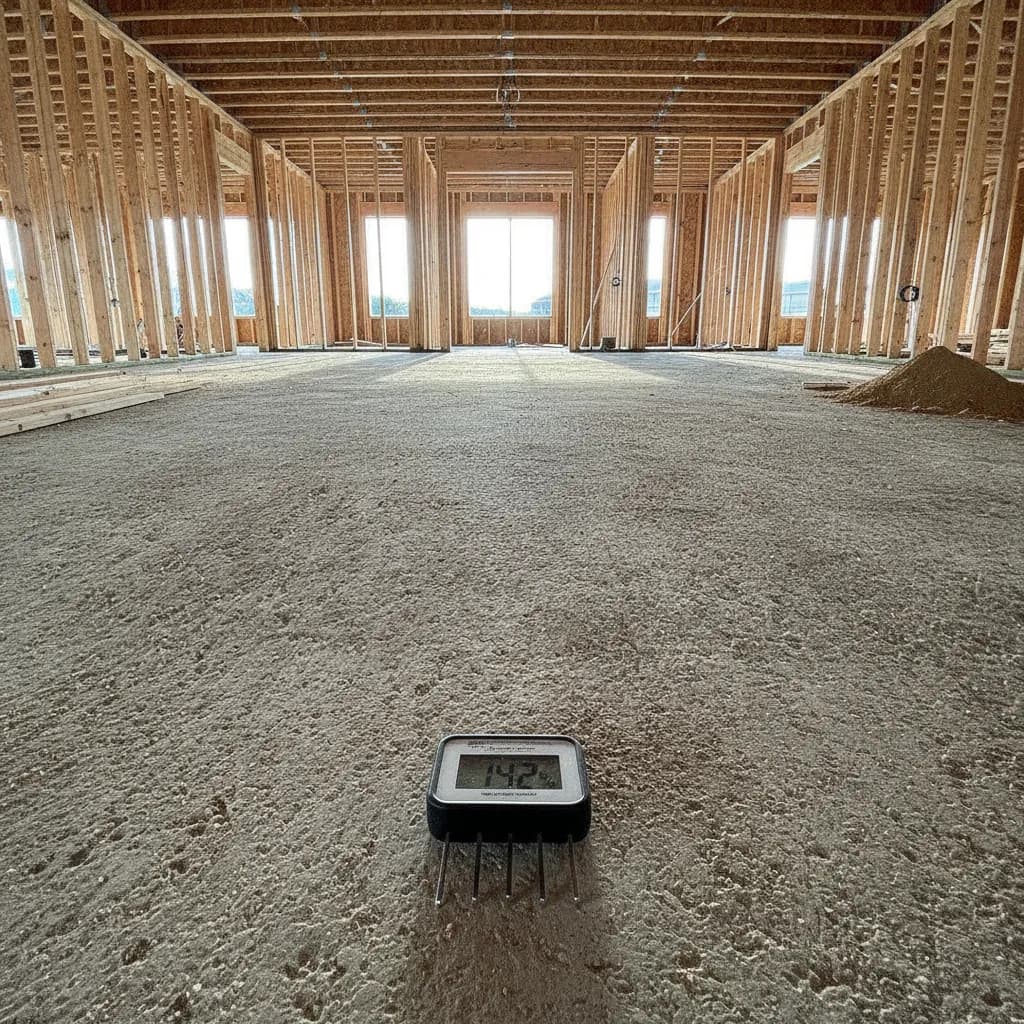
The most reliable way to know whether a slab is ready is to measure the relative humidity inside it, not at its surface. That is what ASTM F2170 does. The method calls for drilling holes into the slab to a specified depth, 40 percent of the slab thickness for a slab drying from one side, inserting sealed probes, and letting them equilibrate before reading the relative humidity deep in the concrete. This matters because it reports the condition the slab will reach after a floor is installed and the top can no longer breathe. Once you cover a slab, moisture redistributes and the interior RH becomes the surface RH. F2170 essentially predicts the future.
The number of test locations is set by the standard: three for the first 1,000 sq ft and one for each additional 1,000 sq ft. In a large multifamily pour, that is a meaningful count, and skipping it to save a day is a false economy. Flooring manufacturers publish an internal RH threshold their products and adhesives are warrantied to, commonly in the 75 to 85 percent range depending on the system. If the slab reads above that ceiling, no honest installer proceeds without either more dry time or a moisture-mitigation system. The reading is not advisory. It is the go/no-go gate, and it belongs in the submittal record alongside the mix design and the manufacturer's installation instructions. Coordinating exactly that paperwork early is the point of our spec and submittal coordination process, so a slab number does not become a surprise at install week.
Calcium chloride (ASTM F1869) and where it still fits
The older test many specs still reference is ASTM F1869, the anhydrous calcium chloride method, which measures the moisture vapor emission rate, or MVER, expressed in pounds of moisture per 1,000 sq ft over 24 hours. A dish of dry calcium chloride is weighed, sealed under a dome on the slab for a set period, then weighed again; the weight gained is the vapor that came up. A common threshold is 3 pounds, with resilient systems often wanting 5 or lower.
F1869 is useful and inexpensive, but it has a real limitation that F2170 does not. Calcium chloride only reads the surface of the slab, the top half inch or so. It cannot see the moisture waiting deeper down. A slab whose surface has dried can pass a calcium chloride test in the morning and still be loaded with vapor that will migrate up once a floor covering caps it. This is why the industry, including the National Wood Flooring Association (NWFA) guidance for wood assemblies, has shifted toward in-situ RH testing as the primary decision tool, with calcium chloride as a supporting data point. On a serious multifamily project, the right practice is often to run both and let the more conservative number govern. Alongside the moisture number, F1869 and F2170 work best when paired with an ASTM F2659 non-destructive scan to map wet zones and a pH check of the slab surface, since high alkalinity destroys many adhesives independent of the moisture reading.
Why ground-floor and podium slabs move vapor year-round in the Treasure Valley
Idaho is high desert, and it is tempting to assume a dry climate means dry slabs. The opposite is often true at the ground level. A slab-on-grade or a structural podium slab sits in contact with the earth, and the ground carries moisture and a vapor drive regardless of how dry the air is above it. Where the vapor retarder under the slab is missing, punctured during the pour, or improperly lapped, the slab becomes a wick pulling ground moisture upward continuously. That drive does not take the winter off. In fact, the temperature differential between warm interior conditioned space and cold winter soil can strengthen the vapor push toward the floor. Ground-floor and podium slabs are therefore the levels most likely to fail and the levels that most need mitigation baked into the spec.
Upper-level slabs behave differently. A fifth-floor deck has no soil contact and only its own mix water to release, so once it dries it tends to stay dry. This split is precisely why a smart multifamily flooring spec is rarely one spec. It is often a different assembly at grade than up top, which we cover in more depth in our multifamily flooring approach. Treating every level identically either overspends on mitigation upstairs or, far worse, underspecs the ground floor where the risk actually lives.
Moisture-tolerant adhesives, vapor retarders, and floating assemblies
Once you have a real number, three families of solution are on the table, and the right one depends on how far the slab reading exceeds the product's limit. The first is a moisture-tolerant adhesive, typically a moisture-cure urethane or an adhesive with a built-in moisture and sound barrier, rated to a stated RH ceiling. These are excellent within their range and simplest to install, but they are not unlimited. If a slab reads 92 percent and the adhesive is rated to 85, the adhesive is not the answer.
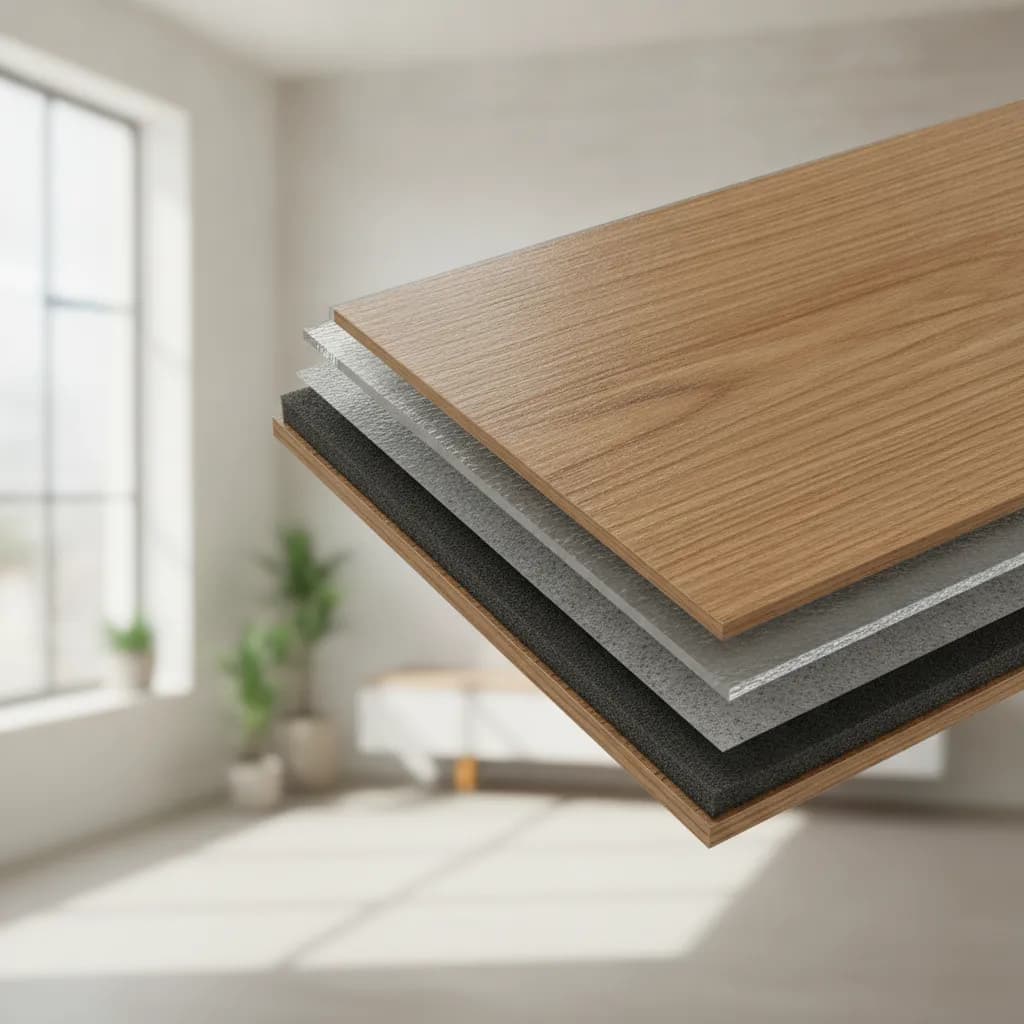
The second solution is a topically applied vapor retarder or moisture-mitigation membrane, most often a two-part epoxy rolled onto the prepared slab that reduces vapor transmission to a level the flooring system can accept. This is the workhorse for wet ground-floor and podium slabs and can rescue a slab reading near saturation. It adds cost and a cure day, but it converts a failing slab into a warrantable substrate, which is far cheaper than a callback. The third solution is a floating assembly: a click-together engineered wood or rigid-core LVT installed over a vapor-retarding underlayment, mechanically uncoupled from the slab so adhesive bond is not the failure point. Floating floors tolerate more moisture, though they still require the vapor drive to be managed and still have their own RH limits. Choosing among these per level, and confirming the product warranty survives the choice, is the core of a defensible multifamily spec.
Matching the assembly to the material and the level
The material selection interacts with all of the above. Solid hardwood is generally the wrong call over any at-grade or podium slab in this climate; it is too sensitive to the combined stresses of slab vapor and the extreme wintertime indoor dryness that forced-air heat produces in the Treasure Valley. Engineered wood, with its dimensionally stable plywood or HDF core, is the far safer wood option over concrete and can be glued down with a moisture-tolerant adhesive or floated depending on the slab number. Rigid-core LVT is the most forgiving over marginal slabs and is why it dominates ground-floor multifamily. Ceramic and porcelain tile, per Tile Council of North America (TCNA) methods, tolerate moisture well but demand an uncoupling or crack-isolation membrane over green slabs and attention to ANSI A326.3 slip resistance in wet entry areas.
There is a second Idaho variable to design for: radiant heat and forced-air dryness. Slabs with embedded radiant tubing must be commissioned and cycled before testing and installation, because heating the slab changes both its moisture state and the wood's equilibrium. And because winter indoor humidity in a heated Boise-metro unit can crash into the teens, wood assemblies need acclimation and a realistic expectation of seasonal movement designed into the gap and transition details. Moisture is not only about too much water in the slab. It is about managing the full range the assembly will see across a year.
Building the moisture story into the schedule and submittal
The cheapest moisture mitigation is time and paperwork. A slab needs drying time before it can pass F2170, and that timeline belongs in the construction schedule from the start, not discovered at install week. The most successful multifamily projects lock in a testing protocol during preconstruction: who tests, to which ASTM method, at what count, against which manufacturer's threshold, and what the remediation path is if a slab reads high. When that plan lives in the submittal package, the go/no-go number is a documented decision rather than an argument. This is the coordination we build with the general contractors and developers we work with, so the flooring scope arrives with its moisture strategy already settled by level and there are no surprises on the critical path.
Concrete slab moisture is a solvable problem. It is solved with in-situ RH testing under ASTM F2170, supported by calcium chloride under ASTM F1869, honest thresholds from the manufacturer, and an assembly matched to the reading and the level. Alderwood Flooring is an Idaho Registered Contractor (Idaho RCE-6681702), insured, and our team brings 20+ years combined experience to specifying moisture-safe floors across the Treasure Valley's multifamily pipeline. If you are planning a podium, a wrap, or a garden-style project and want the slab-moisture strategy right before the floors go down, reach out through our contact form and we will walk your team through a spec that holds up level by level.
Sources & Further Reading


Ready for Floors You'll Love?
Ready to talk through your project? Free estimates throughout The Treasure Valley & Boise Metro.