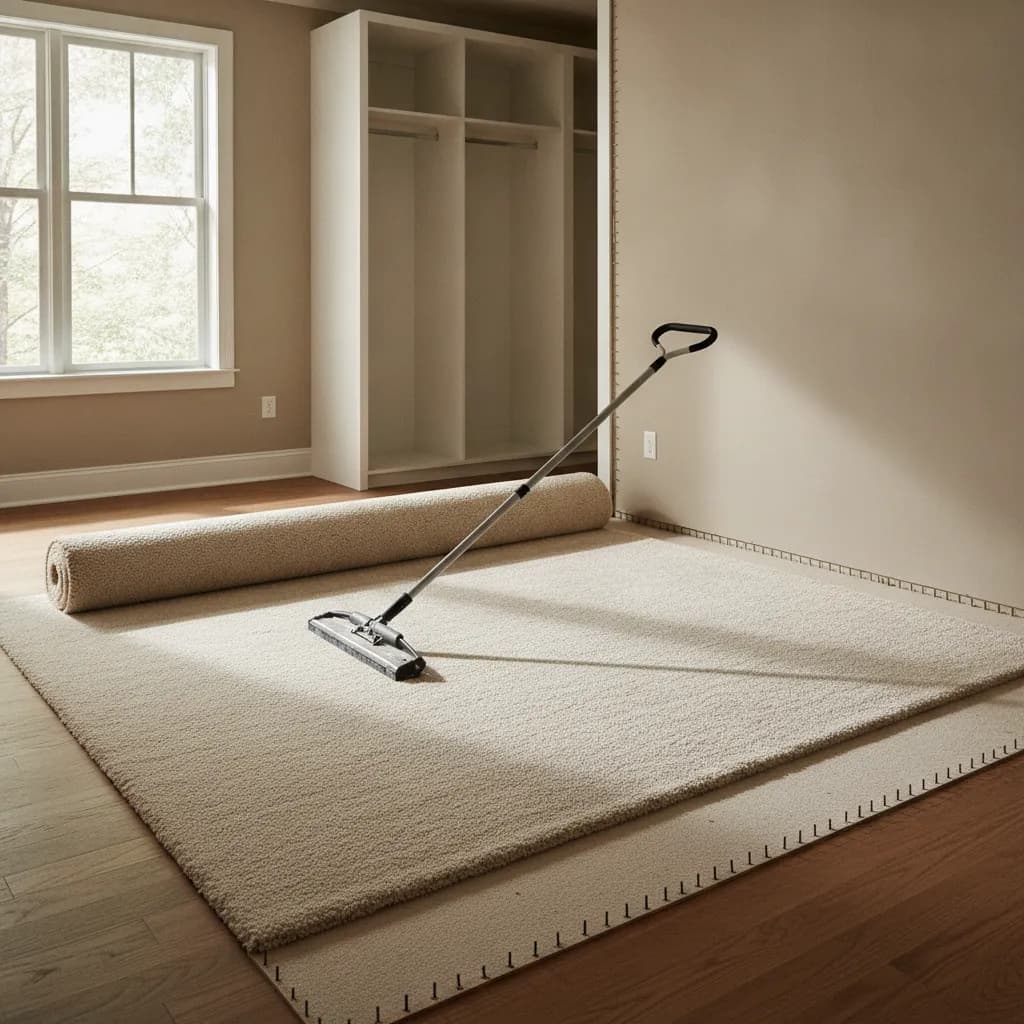
Commercial & Multifamily
Multifamily & Apartments Flooring
Flooring for existing Treasure Valley apartment communities — unit turns, phased renovations, and common areas, delivered with the consistency portfolio work demands.
Apartment flooring is a volume discipline: dozens or hundreds of units that need the same product, the same quality, and the same price, installed on whatever cadence vacancy allows. We work that discipline — waterproof LVP and hard-wearing carpet chosen for tenant reality, an agreed community standard that repeats identically from unit to unit, and scheduling that tracks your vacancy pipeline instead of fighting it.
Occupied-community work takes more care than empty-building work, and we treat it that way: clear notice windows, contained work areas, corridors and amenity spaces phased so residents keep access, and crews that remember they're working in people's homes. Clubhouses, leasing offices, hallways, and fitness rooms get commercial-duty product that stands up to shared use.
For ground-up multifamily construction, that's production work — see our builder program. This segment is for the communities already leasing: turns, renovations, and the long middle of a property's life.
Sound travels differently in stacked units than most owners expect, and the flooring assembly is where footfall complaints usually start. In a garden-style or podium building, the hard-surface plank a resident walks on sits directly over someone else's bedroom, so we look at the whole assembly rather than the wear layer alone. Where the underlayment or the manufacturer's acoustic rating matters to your building type, we can spec an IIC/STC-rated pad under floating LVP or engineered plank and detail perimeter isolation so the floor doesn't telegraph impact noise into the framing. This is worth deciding before the first turn, because matching the acoustic build across future turns keeps the whole stack consistent instead of leaving one loud unit above a quiet one.
Ground-floor and garden units carry a moisture load the upper floors never see, and it changes what belongs on the subfloor. Slab-on-grade units in the Treasure Valley can pass vapor up through the concrete year-round, so before we glue or float anything we run a moisture test on the slab rather than assuming a 40-year-old pour is dry. Where readings come back high, we can move to a moisture-tolerant adhesive or a floating assembly with the right vapor retarder instead of trapping humidity under a finish that will cup or delaminate. Upper units on wood framing behave more like the rest of the building, so it's common to run one spec on grade and a second spec above it rather than forcing one product to cover both conditions.
The seam at a unit's entry door is a small detail that decides how a floor ages, especially with Idaho winters funneling gravel, snowmelt, and mud in from shared breezeways and mudroom transitions. We detail those thresholds so the height change between the corridor product and the unit floor is flush and gasketed where it should be, which keeps grit from grinding under the first three feet of plank and keeps water from wicking into the core at the most-abused edge in the home. On the health side, we treat low-emission material as a baseline rather than an upgrade. Engineered wood flooring is built on a composite-wood core, so it falls under the EPA's TSCA Title VI formaldehyde standard (harmonized with CARB Phase 2) — a federal floor that compliant product sold in the US already has to meet, not a premium tier. Resilient plank is not built on the hardwood-plywood, particleboard, or MDF panels that standard names, so it does not reach resilient product; the meaningful low-emission mark there is FloorScore, which we can specify when indoor air quality is a stated priority. That distinction matters in a sealed, forced-air unit where a resident is breathing that indoor air all winter. Floors that stay flat, quiet, and clean at the entry are also the floors that don't generate a make-ready callback, and a unit that looks cared-for at renewal time is easier to keep leased.
How We Work
Serving Multifamily & Apartments
- One community flooring standard — same product, quality, and pricing every unit
- Turn scheduling aligned to your vacancy pipeline and make-ready deadlines
- Phased renovation of occupied buildings with resident access maintained
- Commercial-duty product for clubhouses, corridors, and amenity spaces
- Idaho-registered (RCE-6681702), insured, warranty-backed installation
Materials
Products We Install
Also see our full commercial & multifamily overview and our trade program for builders, GCs, and property managers.
Good to Know
Frequently Asked Questions
How fast can you turn a vacant unit's flooring?
Turn speed depends on unit size and product, but flooring is scheduled inside your make-ready window rather than around our convenience — and an agreed community standard means no re-scoping delay on each unit.
Will every unit cost the same?
Once a community standard is agreed, identical floor plans price identically — same product, same scope, same number. Budgeting across a portfolio only works when the flooring line stops moving, so we hold it still.
Can you work in occupied buildings?
Yes — common-area and phased renovation work in occupied communities is planned around resident access: notice windows, contained work areas, and corridors kept passable while sections are replaced.
Do you also do new-construction multifamily?
Ground-up production work runs through our dedicated builder program, which handles plan takeoffs, phase scheduling, and punch — this segment covers communities that are already leasing.
Can you reduce footfall noise between stacked apartment units?
Yes, within what the assembly allows. We can install floating LVP or engineered plank over an IIC/STC-rated acoustic underlayment and isolate the perimeter so impact noise doesn't transmit through the framing to the unit below. The realistic gain depends on your existing subfloor and structure, so we'll tell you what a given build will and won't do rather than promise a silent floor.
How do you handle moisture in ground-floor units on a concrete slab?
We test the slab before we commit to a method. A calcium chloride or in-situ RH reading tells us how much vapor the concrete is moving, and from there we choose a moisture-tolerant adhesive, a floating assembly, or a vapor retarder sized to that reading. It's common to run a different spec on grade than on the wood-framed floors above, since the two conditions aren't the same.
Are the flooring products low-emission for indoor air quality?
It depends on the product type, and the distinction is worth knowing. Engineered wood flooring has a composite-wood core, so it falls under the EPA's TSCA Title VI formaldehyde standard (harmonized with CARB Phase 2) — that is a federal requirement for compliant product sold in the US, so it is a baseline rather than a premium option. Resilient plank is not built on the hardwood-plywood, particleboard, or MDF panels TSCA Title VI names, so that rule does not reach it; for resilient the relevant low-emission certification is FloorScore, which we can specify on request. If a building is chasing a specific green certification, we can pull product documentation to match the standard you're reporting to.
Flooring for Multifamily & Apartments
Call (208) 779-4248 to scope your project and get an honest, itemized estimate.