Property Management
Tenant Damage & Flooring Chargebacks
A fair, defensible framework for handling tenant-caused flooring damage: move-in and move-out documentation, useful-life depreciation for deposit deductions, repair-versus-replace scoping, and the records that hold up with owners and in a dispute.
Property Management · 11 min read
Every property manager eventually faces the same tense moment: a tenant moves out, the flooring looks rough, and someone has to decide how much of the security deposit to withhold. Get it wrong in the tenant's favor and the owner absorbs a cost that was not the owner's to eat. Get it wrong in the owner's favor and you invite a small-claims dispute, a bad review, and a demand for documentation you may not have. The difference between a defensible chargeback and an indefensible one is almost never the flooring itself. It is the paper trail, the math, and the consistency of your method.
Flooring is the highest-stakes surface in this conversation because it is expensive, it wears on a predictable schedule, and it is the material tenants damage most: gouged luxury vinyl plank, pet-stained carpet, water-cupped engineered wood, scratched laminate at the slider. In the Treasure Valley, where new multifamily and tract rentals are turning over fast and forced-air heat plus high-desert winter dryness put wood and vinyl through real seasonal movement, the question is rarely "is there damage." It is "is this damage, ordinary wear, or the material simply reaching the end of its useful life." This guide walks through how to answer that fairly and defensibly, and how to build a record you can hand to an owner or a judge without flinching.
We build and repair floors for apartment owners and managers, so we see these disputes from the installer's side of the invoice. What follows is the framework we use when a manager asks us to assess damage, scope a repair, and document it in a way that survives scrutiny.
The legal line: normal wear versus tenant damage
The whole system rests on one distinction that Idaho law, like most states, draws but does not define with a tidy checklist: a landlord may deduct for damage beyond ordinary wear and tear, but not for ordinary wear and tear itself. Ordinary wear is the deterioration that happens when a decent tenant simply lives in the unit — traffic-lane matting in carpet, minor surface scuffing on vinyl, slight gloss loss on a wood finish. Damage is deterioration caused by negligence, accident, abuse, or violation of the lease: a cigarette burn, a pet stain that soaks the pad and subfloor, a chunk gouged out of a plank by a dragged appliance, water left standing until the boards cupped.
The practical test most managers and courts apply combines cause and severity. A worn traffic lane in a carpet that has seen six years of tenants is wear. A three-foot bleach spot in a two-year-old carpet is damage. When you document, you are really documenting cause and severity so the line is obvious to a third party who was never in the room. Photos that show a discrete, localized, abnormal defect make your case; photos that show diffuse, uniform aging undermine it, because uniform aging is the visual signature of wear.
Move-in condition: the record that decides everything later
You cannot prove a tenant caused damage unless you can prove the floor was sound when they took possession. The move-in condition report is the foundation, and a vague one is worse than none because it creates a false sense of security. A usable record is room-by-room, surface-specific, dated, and photographic. For flooring, note the material and its approximate age or install date, the finish condition, and any pre-existing defects with close-up images. Timestamp everything and store originals, not screenshots — metadata matters if authenticity is ever challenged.
Have the tenant acknowledge the report in writing. A signed or e-signed condition report converts your assessment into a shared baseline the tenant helped create, which is far harder to contest at move-out than a one-sided document produced after the fact. Photograph in even, bright light, get the whole floor and the corners, and shoot a few reference angles you can reproduce later so move-out photos line up with move-in photos frame for frame. That visual before/after pairing is the single most persuasive exhibit in any deposit dispute.
Move-out documentation that survives a dispute
At move-out, repeat the move-in process exactly, then add three things: a written narrative of each defect, the cause you believe produced it, and a scope of the remedy. Reproduce your move-in camera angles so the comparison is apples to apples. For odor and pet contamination, photographs are not enough — note where a moisture meter or a UV inspection revealed sub-surface staining, since pet damage often reads worse under the surface than on it, having wicked into the pad, the underlayment, and sometimes the slab.
Keep the record neutral in tone. You are compiling evidence, not building a grievance. Dates, measurements in sq ft, material identification, and plain description of what is abnormal will read as credible; adjectives and frustration will not. When the damage is contested, the file that wins is the one that looks like it was assembled by someone who would have documented the floor the same way regardless of who paid.
Useful life and depreciation: the math behind a fair deduction
Here is where most chargebacks fall apart. Even when a tenant clearly caused damage, you almost never get to bill them the full replacement cost of new flooring. The correct deduction is depreciated: the material had a finite useful life, part of that life was already spent before the tenant arrived, and the tenant owes only for the remaining value they destroyed — not for the years the floor had already given.
The mechanism is straight-line depreciation against an expected useful life. Assign the flooring a reasonable service life, divide replacement cost by that life to get annual value, and charge only the unspent years. If a carpet with an eight-year expected life is ruined in year six, roughly two years — about a quarter of its value — remains, and that fraction, not the whole, is the defensible deduction. Materials carry very different lifespans: apartment-grade carpet often runs five to ten years, sheet vinyl and builder-grade LVP somewhat longer, laminate longer still, and a real wood floor that can be sanded and refinished has the longest life of all because it can be renewed rather than replaced. The NWFA (National Wood Flooring Association) guidance on refinishing versus replacement matters here: a solid or thick-wear-layer engineered wood floor that can take another sanding has residual value a laminate does not, and your depreciation schedule should reflect that.
Two honest caveats keep you defensible. First, a floor already past its useful life has effectively zero depreciated value — you generally cannot charge a tenant to replace a fifteen-year-old carpet no matter how stained, because the owner was going to replace it anyway. Second, publish your schedule and apply it to every unit the same way. A consistent, written depreciation policy is the thing that turns a deduction from an opinion into a defensible calculation.
Repair-and-blend versus full replacement
The size of the chargeback often turns on a scoping decision the tenant never sees: can the damage be repaired and blended, or does the whole floor have to come out. This is both a fairness question and an engineering one. Plank-format floors — LVP, engineered wood, laminate — are designed so individual boards can be lifted and swapped, which means a gouged plank near the kitchen can sometimes be replaced for a fraction of a full re-lay. The catch is dye-lot and wear variation: a new plank dropped into a four-year-old floor can look brighter than its neighbors, and a manager who keeps attic-stock boards from the original install has a real advantage in making a blend disappear.
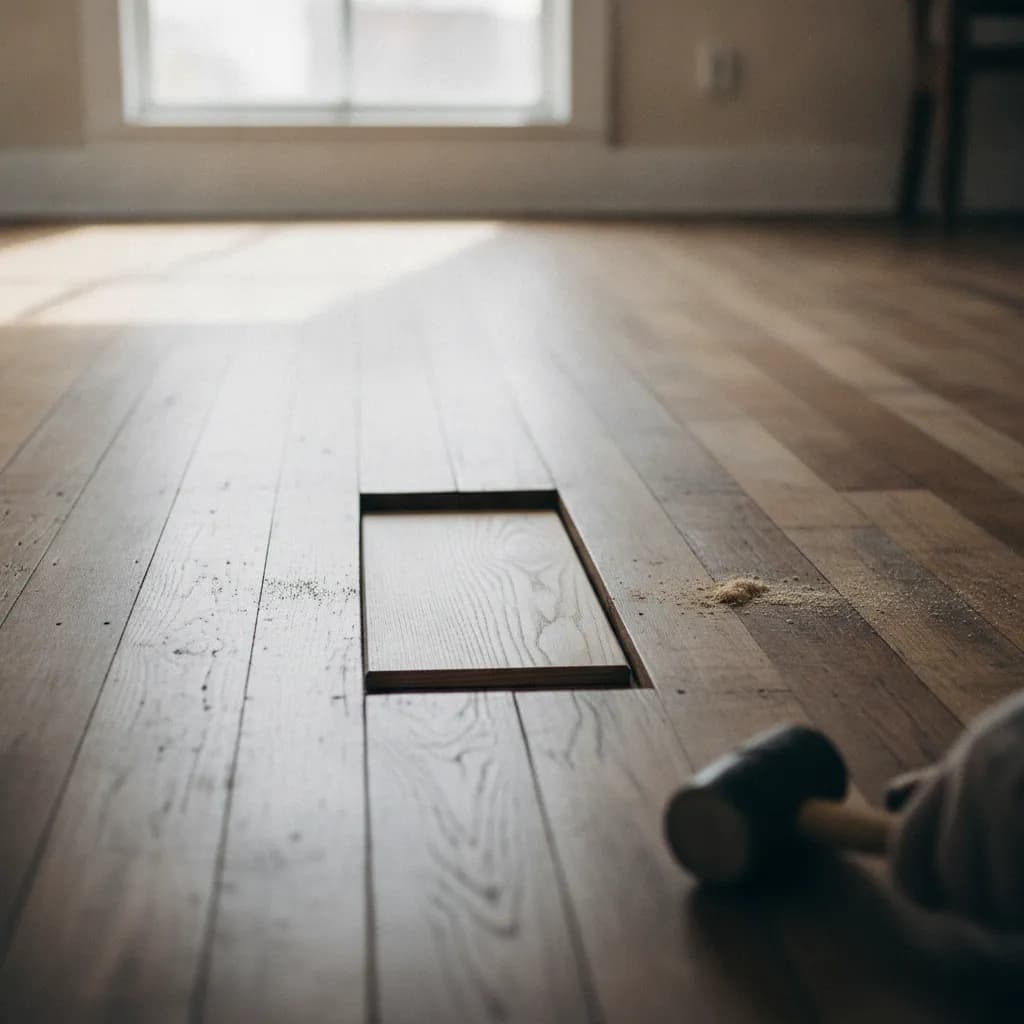
Carpet damage is often repairable too, with a bonded-in patch cut from a closet or a leftover remnant, but a large or centrally located stain usually forces replacement because a patch reads as a patch. Wood offers the widest range: spot-repair a board, sand and refinish a room, or, when cupping from a moisture event has traveled across the floor, replace the affected field. We walk through when a partial swap holds up and when it will simply telegraph in our note on repairing damage without replacing the whole floor, because choosing repair over replacement, when it is genuinely sound, both lowers the tenant's exposure and speeds the turn. Document the reasoning either way — a full-replacement charge is far more defensible when the file shows why a repair was not viable.
Idaho realities that change the analysis
The high-desert climate quietly reshapes several of these judgments. Treasure Valley winters are dry, and forced-air heat pulls indoor humidity even lower, so wood and rigid vinyl shrink and can gap or check seasonally. That movement is not tenant damage — it is the material responding to conditions, sometimes to a home the tenant kept too dry, sometimes to a unit that lacked humidification the owner should have provided. Before charging a tenant for gapping or cupping, rule out an environmental cause, because ASTM moisture protocols and NWFA acclimation guidance both treat wood movement as a humidity phenomenon first.
Slab-on-grade construction, common in newer Valley multifamily, adds slab moisture to the picture: a floor that cupped over a slab may have failed because vapor drove up from below, an installation and moisture-mitigation issue governed by tests like ASTM F2170 and F1869, not because a tenant spilled. Snow, gravel, and mud tracked through entries and mudrooms cause abrasion that is genuinely tenant-adjacent but often reads as ordinary wear absent a walk-off mat requirement in the lease. And radiant-heated slabs impose their own movement regime that can mimic damage. Sorting climate-driven change from tenant-caused damage is exactly the kind of call an installer's assessment can settle — and it protects you from charging for a defect the owner or the building actually caused.
The owner-ready file: what to forward and keep
The last step is assembling everything into a package an owner can approve and a judge could read cold. A complete chargeback file contains the signed move-in condition report with photos, the matching move-out report with reproduced angles, the damage narrative with cause and severity, the depreciation calculation showing useful life and remaining value, the repair-versus-replace scope with reasoning, and the itemized estimate or invoice. Deliver the tenant's itemized deduction statement within the deadline your lease and Idaho law require, because a technically valid deduction can still be forfeited on a timing or notice defect.
Consistency across the portfolio is what makes any single file bulletproof, and it is easier to defend a deduction when the owner already understands your method. We help managers standardize this documentation and fold flooring condition into routine owner communication in our note on owner reporting and warranty records, so the depreciation schedule and photo standard are the same in every unit. When the record is uniform, a tenant challenging one deduction is really challenging your whole system — and a well-built system holds.
Alderwood Flooring works with apartment owners and property managers across the Treasure Valley and Boise metro to assess tenant flooring damage, scope repair-or-replace decisions, and produce the depreciated, documented estimates that make a chargeback defensible. As an Idaho Registered Contractor (Idaho RCE-6681702), insured, with 20+ years combined experience, our team can put an installer's eye behind your deposit decisions. If you manage rentals and want a repeatable way to handle flooring damage fairly, reach out through our apartment owners and operators page or the contact form, and we will help you build the record before you need it.
Explore related

Ready for Floors You'll Love?
Ready to talk through your project? Free estimates throughout The Treasure Valley & Boise Metro.