Property Management
Apartment Unit-Turn Flooring Playbook
A working playbook for flooring on apartment unit turns in the Treasure Valley: vacancy-day math, one community standard, repair-and-blend decisions, and scheduling so the floor never holds a unit off the market.
Property Management · 10 min read
Flooring is the single line item on a unit turn most likely to blow the make-ready window. Paint dries on a predictable clock. Cleaning is a fixed crew and a fixed number of hours. Flooring is where the surprises live: the plank that was discontinued two years ago, the subfloor that reads wet on a meter, the odd-lot leftover in the maintenance closet that no longer matches anything on the shelf. When a turn slips from five days to twelve, flooring is usually somewhere in the story. For an owner or operator running dozens of doors across the Treasure Valley, that slippage is not a nuisance. It is real money leaving the building one vacant day at a time.
This playbook treats flooring the way a good operations team treats any repeatable process: as a system with a standard, a decision tree, and a schedule that holds under pressure. The goal is not the prettiest floor. The goal is a floor that installs fast, wears hard, blends cleanly on partial repairs, and never becomes the reason a leasable unit sits dark. That distinction matters in Idaho specifically, where high-desert winters, forced-air heat, and a construction boom that keeps handing renters brand-new comparison units all raise the bar on what "rent-ready" has to look like. Alderwood Flooring works with apartment owners and managers to build exactly this kind of standardized, turn-ready program, and the sections below lay out how the pieces fit.
The Real Cost of a Vacant Day
Start with the math, because it reframes every decision that follows. Take a unit's monthly rent, divide by 30, and you have the daily carrying cost of vacancy. A unit renting at 1,500 dollars costs roughly 50 dollars a day empty. That number sounds small until you multiply it by the number of days flooring adds to a turn, then by the number of turns a community runs in a year. If flooring routinely adds three avoidable days to each of 120 annual turns, that is 360 vacant days, or roughly 18,000 dollars, tied up in nothing but scheduling friction and material mismatches. The flooring itself did not cost that. The delay did.
Once you see the daily number, the priorities reorder themselves. A slightly more expensive plank that installs a day faster and repairs without a full-room replacement is not more expensive at all. It is cheaper, because it buys back vacant days that would otherwise never come back. The apartment ownership view of flooring is a portfolio view: not the cost of one floor, but the cost of the turn cadence across every door, every year. Every recommendation in this playbook is built to protect that cadence.
One Community Product Standard
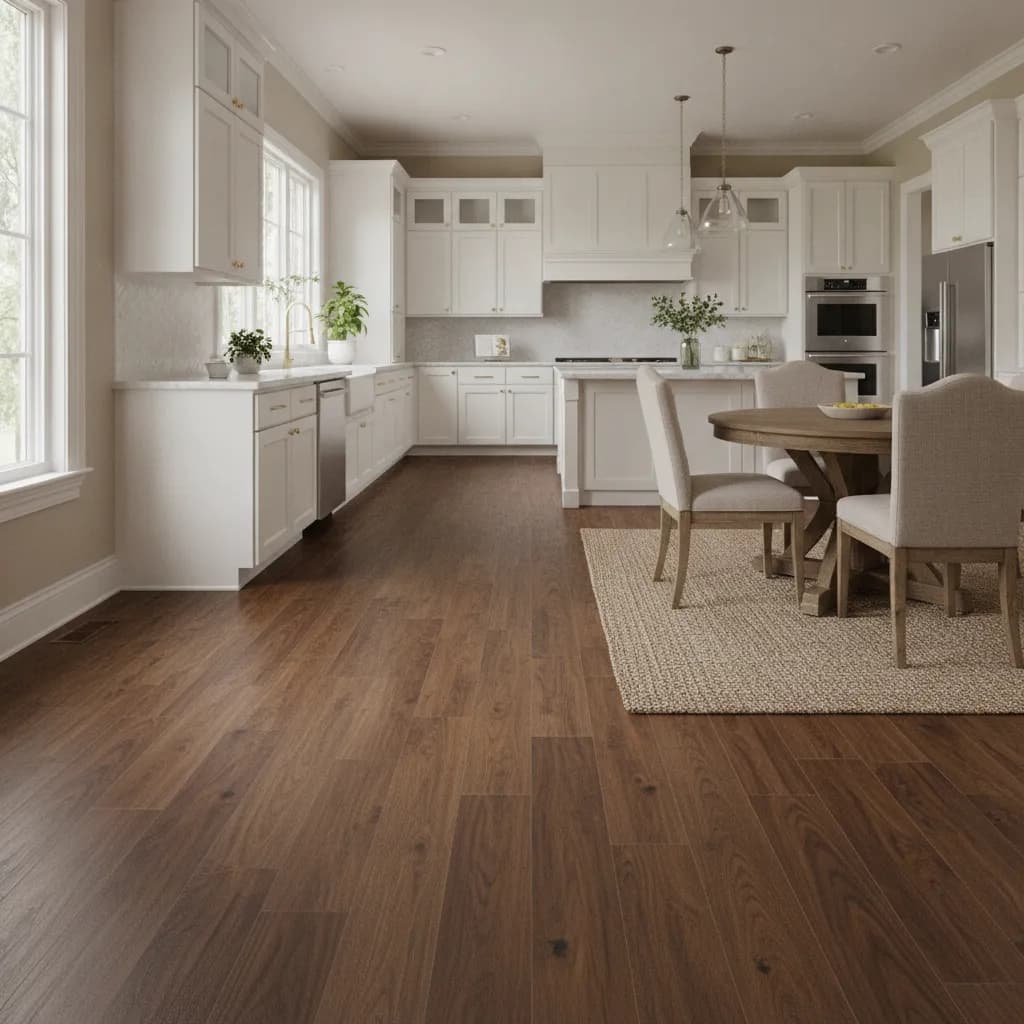
The most powerful move an operator can make is also the least glamorous: pick one flooring standard per community and hold it. A single luxury vinyl plank product, one color, one wear layer, one plank dimension, specified across every unit type in the property. The reason is not aesthetics. It is inventory logic. When every unit runs the same floor, a partial repair pulls from the same box the last repair pulled from. A discontinued color stops being a crisis because you are managing one SKU, not fourteen leftover odd lots scattered by whoever happened to be running turns that quarter.
Luxury vinyl plank has become the default turn surface for good engineering reasons, not fashion. It is dimensionally stable across the humidity swings a Treasure Valley unit sees between a bone-dry January and a wet spring. It is waterproof at the plank level, which matters in kitchens, baths, and the mudroom-style entries that take snowmelt, gravel, and ice-melt salt every winter. And it installs as a floating floor over a sound, flat, dry subfloor without the cure times a glue-down or a wet-set demands. When you standardize, buy the wear layer up front. A 20-mil wear layer costs more per square foot than a 6- or 12-mil, but in a rental it is the difference between a floor that survives multiple tenancies and one that telegraphs every dog nail and dragged couch by the second lease. Specify the product for the life of the asset, not the life of one turn.
Standardization also protects indoor air quality, which is a genuine leasing and liability concern, not a box-check. Specify products that carry FloorScore certification for low VOC emissions, and confirm compliance with CARB Phase 2 formaldehyde limits on any composite core. The EPA's guidance on indoor air quality is worth reading for anyone furnishing units people sleep in every night; a certified low-emitting floor is cheap insurance against complaints you cannot easily walk back. Alderwood specifies to these standards as a default so the community standard is defensible on paper, not just on the showroom sample.
Durability Under Tenant Wear
A rental floor lives a harder life than an owner-occupied one and gets none of the care. Furniture drags. Nobody uses felt pads. Pets are common, and pet claws are the number-one visible-wear complaint on apartment flooring. Entries take the worst of Idaho's seasons: gravel tracked from parking lots, snowmelt, and the salt and de-icer that chew at finishes. The floor you spec has to shrug all of that off for years, because the tenant who abuses it is not the tenant who will pay to fix it.
This is where wear layer, plank rigidity, and finish do the real work. A rigid-core LVP resists the point-load denting that a flexible plank shows under table legs and appliance feet. A thick, urethane-topped wear layer resists the micro-scratching that dulls a floor's appearance long before it structurally fails. Pay attention to slip resistance too, especially in kitchens and entries where water lands. ANSI A326.3 defines the dynamic coefficient of friction (DCOF) test that quantifies wet slip resistance; specifying to a known DCOF value is how you turn a vague safety worry into a documented spec. The National Wood Flooring Association (NWFA) guidelines are the reference point when a community runs real hardwood in premium units, but for the standard turn floor, rigid-core LVP is almost always the honest answer.
Repair-and-Blend Versus Full Replacement
The core turn decision on any occupied-then-vacated unit is simple to state and easy to get wrong: fix the damaged area, or replace the whole floor. Full replacement is clean, predictable, and expensive, and it wastes serviceable material. Repair-and-blend is faster and far cheaper, but it only works if the product was standardized and if the installer can make the new planks disappear into the old. This is precisely why the one-standard rule pays off. When the community runs a single SKU and you have kept attic stock from the original install, a blown-out entry or a pet-stained bedroom becomes a two-hour patch instead of a two-day gut.
The judgment call is where craft matters. A floating LVP floor can be opened at the wall, worked back to the damaged planks, and re-locked with replacements, but the blend has to account for how the existing floor has aged under UV and traffic. A brand-new plank dropped into a five-year-old floor can read as a bright rectangle if the color has shifted. An experienced installer plans the seam, feathers the replacement into a natural break in the pattern, and knows when a room has drifted too far to blend and honestly needs full replacement instead. The right call protects both the vacancy clock and the leasing photos. Alderwood's crews are set up to make that call on walk-through and to carry and log attic stock so the second repair is as clean as the first.
Reading the Subfloor Before You Commit
Nothing derails a turn faster than laying finish flooring over a subfloor that was not ready. On slab-on-grade units, common in newer Treasure Valley multifamily, concrete moisture is the hidden killer. Test it. ASTM F2170 covers in-situ relative humidity probes, and ASTM F1869 covers the calcium chloride moisture-vapor-emission test; a floor installed over a slab that fails these will cup, telegraph, or debond no matter how good the plank is. Over wood-framed subfloors, the issue is flatness and fastening: a floating floor needs a flat plane, typically within 3/16 inch over 10 feet, or it will click and flex underfoot and tenants will call it in as a defect.
For any unit with radiant heat, add a step. Slab and radiant temperatures have to be brought up and stabilized on a schedule before and after install, and the flooring has to be rated for radiant use, or you will see gapping through the first heating season. Building this test-and-prep step into the standard turn checklist is what separates a program that holds from one that produces callbacks. A callback is a second visit, a second scheduling window, and sometimes a re-vacancy, all of which are far more expensive than the meter reading that would have caught it.
The Idaho Moisture and Movement Problem
Idaho's climate deserves its own line in the playbook because it drives two failure modes operators elsewhere rarely see. First, winter dryness. High-desert air plus forced-air heating can drop indoor relative humidity into the teens for weeks. Real wood floors respond by shrinking and gapping; even engineered wood moves. This is a major reason the standard turn floor leans toward dimensionally stable LVP rather than solid hardwood, and why any premium hardwood unit should carry guidance about winter humidification to keep the interior in a sane range. Second, seasonal swing. A unit that runs bone-dry in January and humid in a wet spring puts any floor through an annual expansion-and-contraction cycle, which is exactly why floating-floor expansion gaps at the perimeter are not optional and must never be caulked shut or pinned under baseboard.
The practical upshot for a turn program is that the product spec and the installation details have to be chosen for Idaho conditions, not copied from a national playbook written for a mild coastal market. Proper acclimation, correct perimeter gaps, and a moisture-verified subfloor are the difference between a floor that lasts through several tenancies and one that generates a warranty visit every spring.
Scheduling So Flooring Never Holds the Unit
The final piece is sequencing, because even a perfect product installed by a perfect crew will still blow the window if it is scheduled wrong. Flooring has to land in the turn at the right moment: after demolition, plumbing, and any drywall or paint that would drip or dent a finished floor, but with enough buffer that a moisture failure or a material shortfall does not cascade into every trade behind it. The communities that turn fastest treat flooring as a scheduled, committed slot with a known duration and a service-level agreement, not a "call when the unit's empty" afterthought.
That is the whole point of building a turn-scheduling SLA with your flooring partner: a standing commitment on lead time, on-site duration, and communication so the property manager can sequence paint and cleaning around a date they can actually trust. Pair it with a clear make-ready flooring process that spells out who reads the subfloor, who logs attic stock, who decides repair-versus-replace, and how a surprise gets escalated the same day instead of surfacing on move-in morning. When flooring is a known quantity on the schedule, it stops being the variable that determines whether a unit makes the market on time. It becomes the trade nobody has to worry about.
Bringing It Together
A flooring program that protects the turn cadence is built from a handful of disciplined choices: run one product standard per community, buy the wear layer for the life of the asset, verify the subfloor before every install, blend repairs instead of gutting rooms when the standard allows it, respect Idaho's moisture and movement realities, and lock flooring into the turn schedule with a commitment you can plan around. Do those things and flooring stops being the line item that surprises you and becomes one of the most predictable parts of the make-ready.
Alderwood Flooring builds this kind of standardized, turn-ready program with apartment owners and operators across the Treasure Valley and greater Boise metro. As an Idaho Registered Contractor (Idaho RCE-6681702), insured, and backed by 20-plus years of combined experience and a workmanship warranty, the team is set up to specify a community standard, hold attic stock, and schedule installs so the floor is the trade you never have to think about again. If you are running turns and want flooring off your critical path, reach out through the contact form to start mapping a standard for your community.
Sources & Further Reading



Ready for Floors You'll Love?
Ready to talk through your project? Free estimates throughout The Treasure Valley & Boise Metro.