Property Management
Short-Term Rental & Hospitality Flooring
How to spec flooring for short-term rentals, hospitality units, and McCall mountain properties — waterproof, scratch-resistant, quiet, and fast to clean between guests, engineered for Idaho's dry winters and freeze-thaw cycles.
Property Management · 11 min read
A short-term rental floor lives a harder life than almost any residential floor and most commercial ones. It gets rolling luggage dragged across it every three days, wet boots at the door, a bathtub that overflows at 2 a.m. with nobody there to catch it, and a cleaning crew on a two-hour window who will mop it aggressively and photograph it for the listing. Then, in a mountain market like McCall or Donnelly, the building sits empty and unheated for a stretch in shoulder season while the outside temperature swings 40 degrees in a day. The floor has to survive all of that, look good in a wide-angle listing photo, and clean fast enough that housekeeping never falls behind. That is a genuinely demanding spec, and it is different from what you would put in a long-term apartment or an owner-occupied home.
This guide walks through how we think about flooring for short-term rentals and hospitality units across the Treasure Valley and the mountains above it. The engineering priorities are turnover durability, water resistance, sound control for stacked units, and dimensional stability through Idaho's dry, forced-air winters and freeze-thaw cycles. The finishing priorities are photogenics and cleanability. Those two lists pull in slightly different directions, and the whole job of a good spec is resolving that tension deliberately rather than by accident. Alderwood Flooring works as a service-area contractor throughout the region, and everything below is written as capability and method — how the work gets done and what to weigh — not a claim about any particular finished property.
Guest Turnover Is a Wear Cycle, Not a Traffic Rating
Manufacturers rate flooring for foot traffic, but a short-term rental does not wear like foot traffic. It wears in cycles. Every checkout brings a compressed burst of abuse: suitcases, cleaning equipment, furniture nudged and put back, a vacuum run hard along baseboards. Multiply that by 100-plus turnovers a year and you have a wear profile closer to a busy retail entry than to a home. The NWFA (National Wood Flooring Association) publishes wear-layer and finish guidance that is useful here, but the practical lesson is simpler: spec for the abrasion of the turnover, not the average day.
For most STR and hospitality applications we steer toward rigid-core luxury vinyl plank (SPC or the better WPC constructions) with a wear layer of at least 20 mil, and 22 to 28 mil where budget allows. Wear layer is the single number that best predicts how a rental floor ages. A 12-mil residential product will telegraph luggage scuffs within a season; a 20-mil-plus commercial-grade wear layer shrugs them off. Where an owner wants real wood for a premium listing, engineered hardwood with a thick sawn wear layer and a factory aluminum-oxide finish is defensible, but it demands more forgiveness from guests and more care from housekeeping, so we reserve it for higher-nightly-rate properties where the look earns its keep.
Waterproof Is a System, Not a Product
"Waterproof plank" is a marketing phrase that describes the plank, not the floor. The plank core may be impervious, but water finds the seams, the perimeter, and the transitions. In a unit where a guest will absolutely, eventually, leave a tub running or track in snowmelt, you protect the assembly, not just the surface.
That means specifying the perimeter and wet areas as carefully as the field. In bathrooms and at entries we favor a fully adhered installation or, for tile, a proper waterproofing membrane and sealed grout meeting the RFCI and ANSI installation standards for wet applications. Grout joints in a rental bathroom should be epoxy or a high-performance cementitious grout with a penetrating sealer, because standard grout stains and harbors mildew in exactly the corners a two-hour cleaning turn will miss. Slab moisture matters too: before any resilient or wood floor goes down on grade, we test per ASTM F2170 (relative humidity in the slab) or ASTM F1869 (calcium chloride) so the moisture coming up from below never becomes the cause of a cupped or delaminated floor six months in. Skipping that test is the most common way a "waterproof" floor still fails.
Quiet Floors for Stacked Units
If your property is a duplex, a triplex, a stacked condo, or a converted building with units over units, impact sound is a guest-satisfaction issue and sometimes a code issue. Nothing generates a one-star review faster than footsteps from the unit above at midnight. The relevant acoustic metrics are IIC (Impact Insulation Class, tested per ASTM E492) for footfall and STC (Sound Transmission Class, tested per ASTM E90 and rated by ASTM E413) for airborne sound. The IBC sets a floor-ceiling assembly minimum of 50 (45 field-tested) for both in many multifamily occupancies, but 50 is a minimum, not a comfort target.
For a rental where the whole point is that guests sleep well, we aim higher and treat the underlayment as an acoustic component, not a leveling afterthought. A quality acoustic underlayment under rigid-core plank, or a resilient mat under an engineered wood floating floor, meaningfully raises delta-IIC. In serious conversions we look at the whole assembly — the plank, the underlayment, and whether the subfloor or ceiling below needs a resilient channel or additional mass. This is exactly the kind of detail that separates a floor that merely passes inspection from one that a paying guest never notices, which is the goal. If you operate multiple stacked units, our guidance for property managers goes deeper on standardizing acoustic assemblies across a portfolio.
The Idaho Problem: Dry Winters and Wood Movement
The Treasure Valley and the mountains above it are high desert. Winter forced-air heat can drop indoor relative humidity into the teens for weeks. Wood is hygroscopic — it gives up moisture to dry air and shrinks — so a solid or engineered wood floor installed at a comfortable 40 percent RH will develop gaps as the heating season pulls it down to 15 percent. This is not a defect; it is physics, and it is why we condition materials to the space before installation and why the NWFA acclimation guidance exists.
For STR owners the honest trade-off is this: real wood looks unbeatable in listing photos but moves with Idaho's seasons, and a rental will not have an owner running a humidifier all winter. Rigid-core LVP does not care about ambient humidity, which is a large part of why it dominates the rental and hospitality market here. When an owner does want wood, engineered construction with a stable plywood or HDF core moves far less than solid, and we design the layout with the right expansion gaps and transitions so seasonal movement is absorbed at the perimeter instead of showing up as a buckle in the middle of the living room. Managing that seasonal cycle is a recurring theme in how we approach durable rental flooring, and it applies doubly to properties that photograph in summer and get abused in winter.
Mountain Cabins: Freeze-Thaw and Seasonal Vacancy
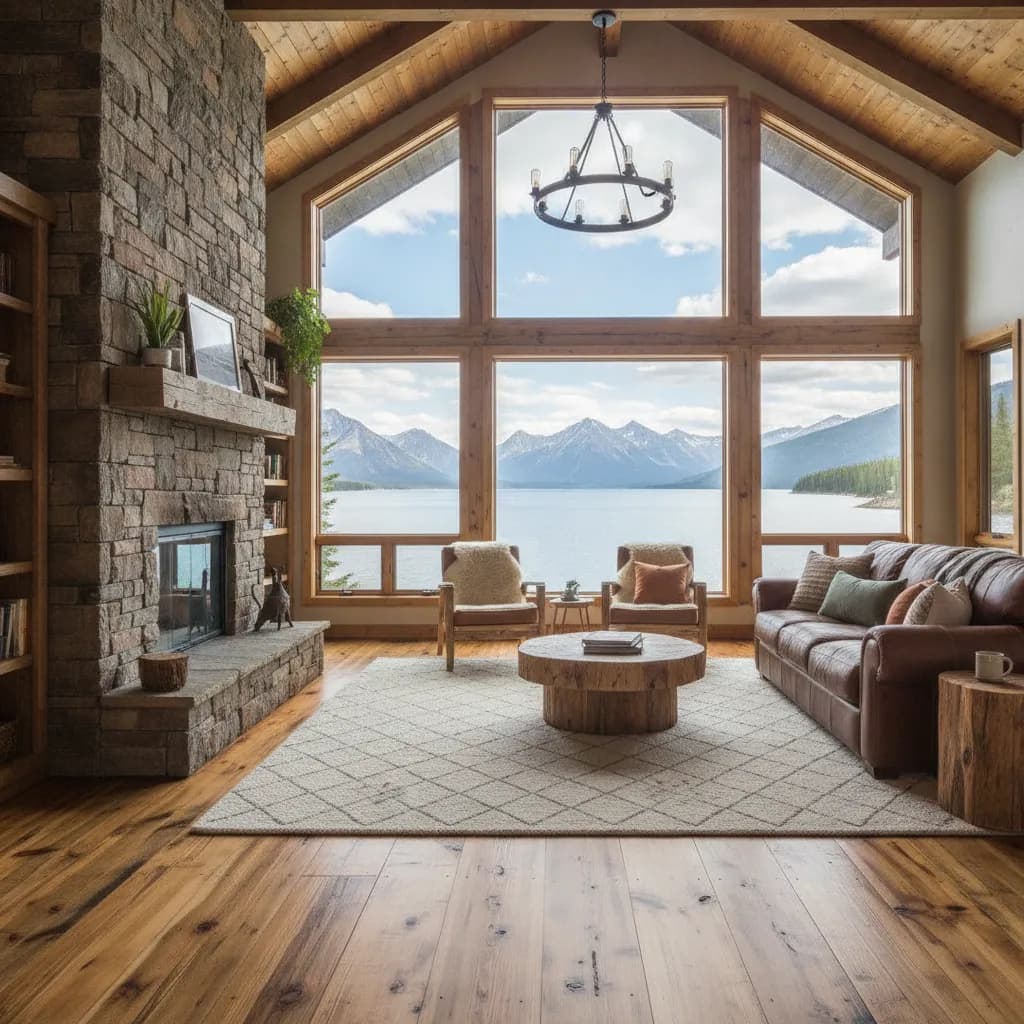
McCall, Donnelly, Cascade, and the Payette Lakes properties add a second stressor: the building is not always heated. A cabin that sits at 55 degrees, or lower, through a vacancy stretch, then gets cranked to 70 when guests arrive, subjects the floor to thermal cycling that a valley townhouse never sees. Floating floors expand and contract with those swings, and a floor installed tight in warm conditions can buckle when it is heated hard after a cold spell — or gap when it is left cold.
The engineering answer is disciplined expansion gaps, the manufacturer's specified installation temperature range respected on install day, and product chosen for thermal stability rather than the cheapest click-lock on the shelf. Below-grade and on-grade slabs in mountain builds also see more moisture drive, so the same ASTM F2170 slab testing becomes even more important. For lake-adjacent and forested lots, entry management matters as much as product: gravel, pine needles, and snowmelt are abrasive and wet, and the mudroom is where a floor either earns its keep or gets destroyed. Our work in the McCall and Payette Lakes area is built around exactly these cold-climate realities rather than a valley spec copied uphill.
Entries, Mudrooms, and the War on Grit
Most floor damage in this region walks in through the front door. Grit is abrasive; snowmelt is water; and rolling luggage grinds both into the finish right at the threshold. The cheapest, highest-return upgrade on any Idaho rental is a well-designed entry: a durable, textured, easy-to-clean surface at the door, a walk-off zone deep enough that a guest actually crosses it, and a transition detail that keeps water from wicking under the adjacent field flooring.
In mudrooms and heavy entries we often specify porcelain tile with a slip-resistant surface, which matters both for guest safety and for your liability exposure. The relevant metric is dynamic coefficient of friction under ANSI A326.3 (DCOF); a wet-rated value there is what keeps a snow-wet entry from becoming a fall. Where the design calls for plank continuity from the door through the living space, we choose a textured, high-wear-layer product and detail the threshold so meltwater has somewhere to go. It is unglamorous specification work, and it is the difference between a floor that looks new after two winters and one that is visibly worn in a three-foot arc at the door.
Finishes That Photograph Well and Clean Fast
A short-term rental floor has a marketing job. It appears in the hero photo, and it needs to read as clean, warm, and current in a wide-angle shot taken under mixed lighting. At the same time, it has to actually clean fast, because housekeeping's window is short and their tools are blunt. Those two demands overlap more than owners expect if you choose the finish deliberately.
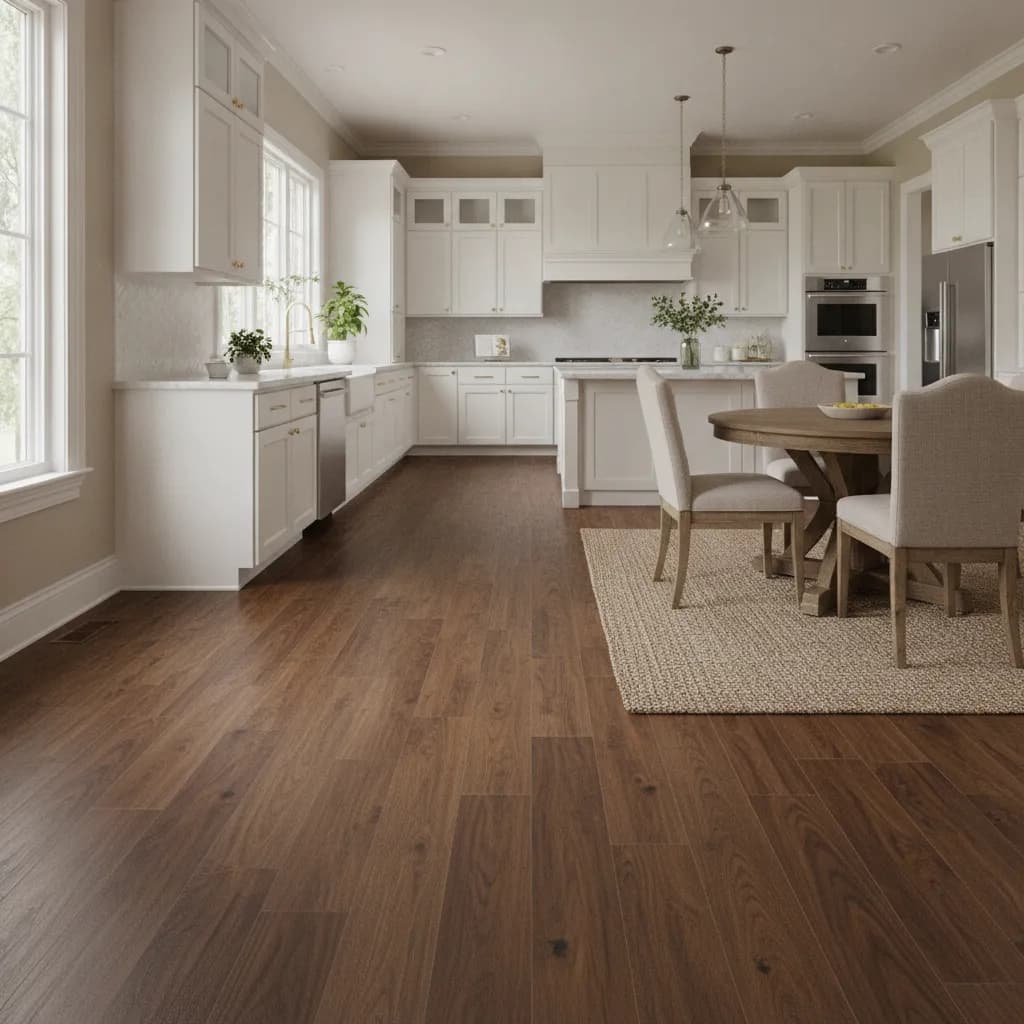
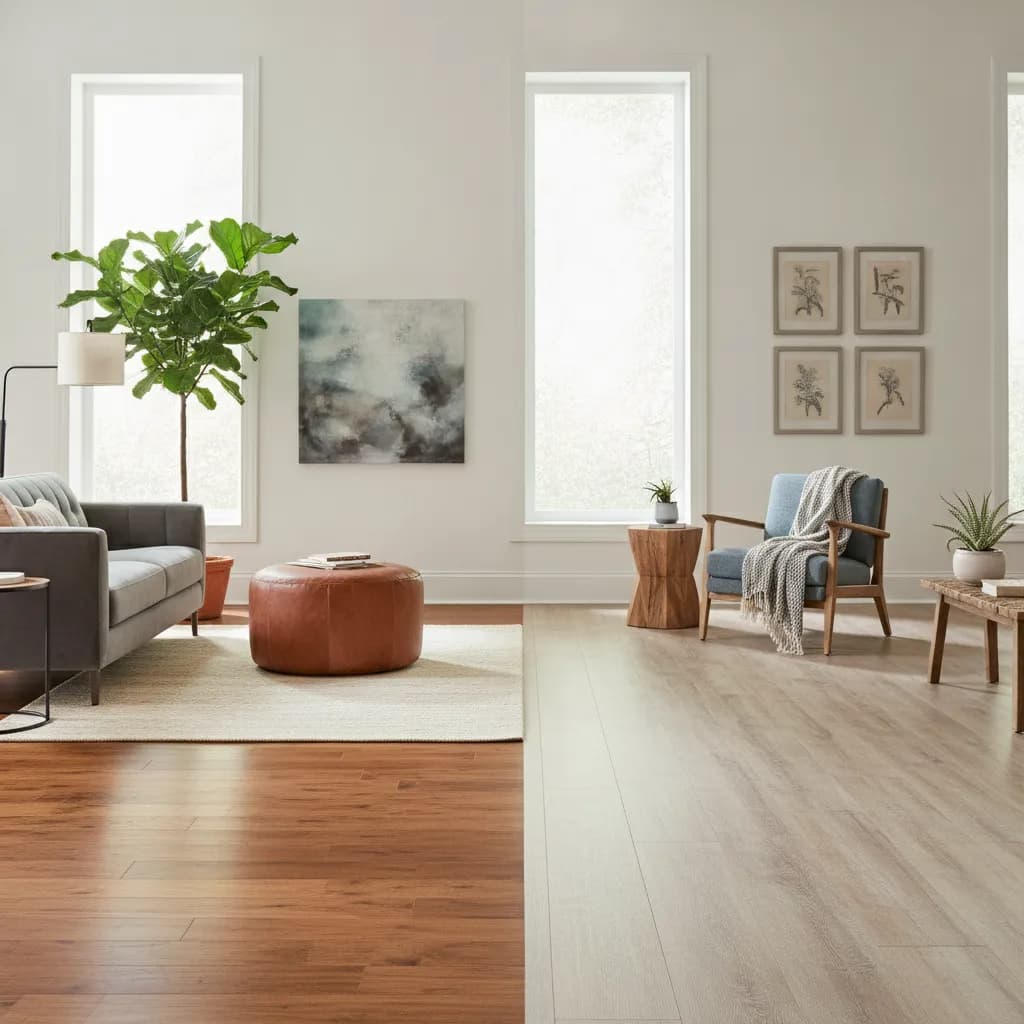
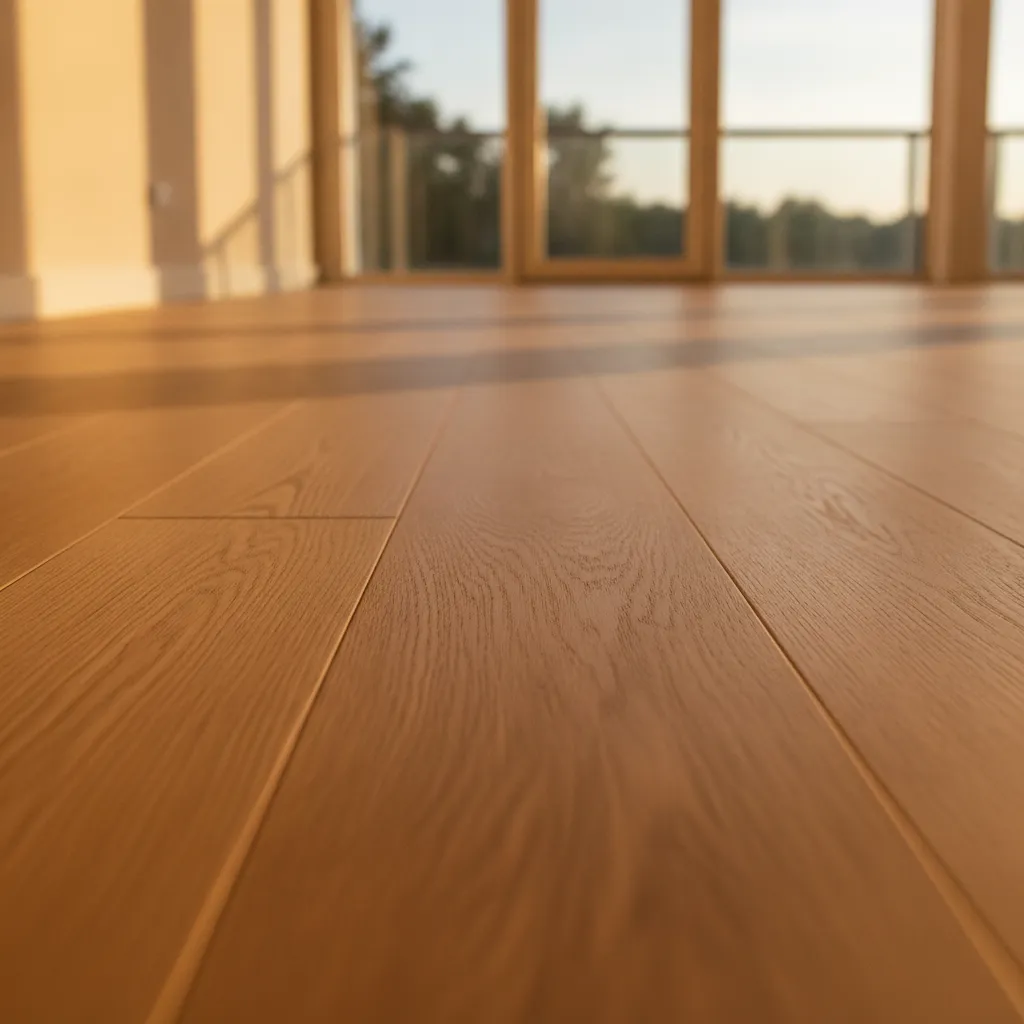
High-gloss surfaces photograph as luxurious but show every scuff, streak, and dust mote — a maintenance nightmare on a turnover schedule. Very heavy, deep-embossed textures hide wear but trap grime in the grain and slow down mopping. The sweet spot for rentals is a low-to-medium sheen with a light, realistic texture: it disguises the micro-scratches of daily turnover, photographs as authentic wood rather than plastic, and wipes clean in one pass. Color choice follows the same logic — mid-tone, warm neutrals hide crumbs and hair between cleans far better than either very dark or very pale floors, both of which show everything. We help owners pick a spec that survives the guest, satisfies the camera, and respects the cleaner's clock, because in this business those three constituencies all have to be happy or the reviews suffer.
Standardizing the Spec Across a Portfolio
If you operate more than a handful of units, the smartest move is to standardize on one or two flooring systems across the portfolio. A single spec means you carry attic stock for fast repairs, your cleaning crews learn one maintenance routine, and a damaged plank in unit 6 is a same-day swap rather than a custom order. It also lets you negotiate material better and keeps your listings visually consistent, which quietly reinforces a brand. For fast-growing Treasure Valley operators adding tract-built and new multifamily units, locking a standard early — before you own 20 different floors bought on 20 different closing days — saves real money and real turnover time down the road.
Alderwood Flooring is an Idaho Registered Contractor (Idaho RCE-6681702), insured, and backs its installation work with a workmanship warranty. Our team brings 20+ years of combined experience to specifying and installing floors that are built for the specific stresses of Idaho hospitality — turnover abrasion, dry-winter movement, mountain freeze-thaw, and the two-hour cleaning turn. If you are building, renovating, or restocking short-term rentals or hospitality units anywhere from Boise to the Payette Lakes, reach out through our contact form and we will help you land on a spec that survives your guests and photographs like it never met one.
Explore related
Ready for Floors You'll Love?
Ready to talk through your project? Free estimates throughout The Treasure Valley & Boise Metro.