Cost & Value
Refinish or Replace Hardwood Floors? The Decision Math
Wear-through, prior sand count, damaged-board share — the refinish-or-replace call comes down to a handful of measurable factors. Here's the framework, without the sales thumb on the scale.
Cost & Value · 6 min read
Sooner or later every hardwood floor reaches the crossroads: it looks rough enough that something must be done, and the something is either sanding it back to life or tearing it out for new. The two paths differ enormously in cost, disruption, and outcome, and the right choice is more measurable than most homeowners expect — it hangs on a handful of physical facts about the floor, not on taste or a contractor's mood. It's worth knowing that the question also carries a built-in bias: a company that only sells new floors has one answer for you, and a company that does both has less reason to lean. Here's the framework we actually use.
First Sort: What Kind of Tired Is It?
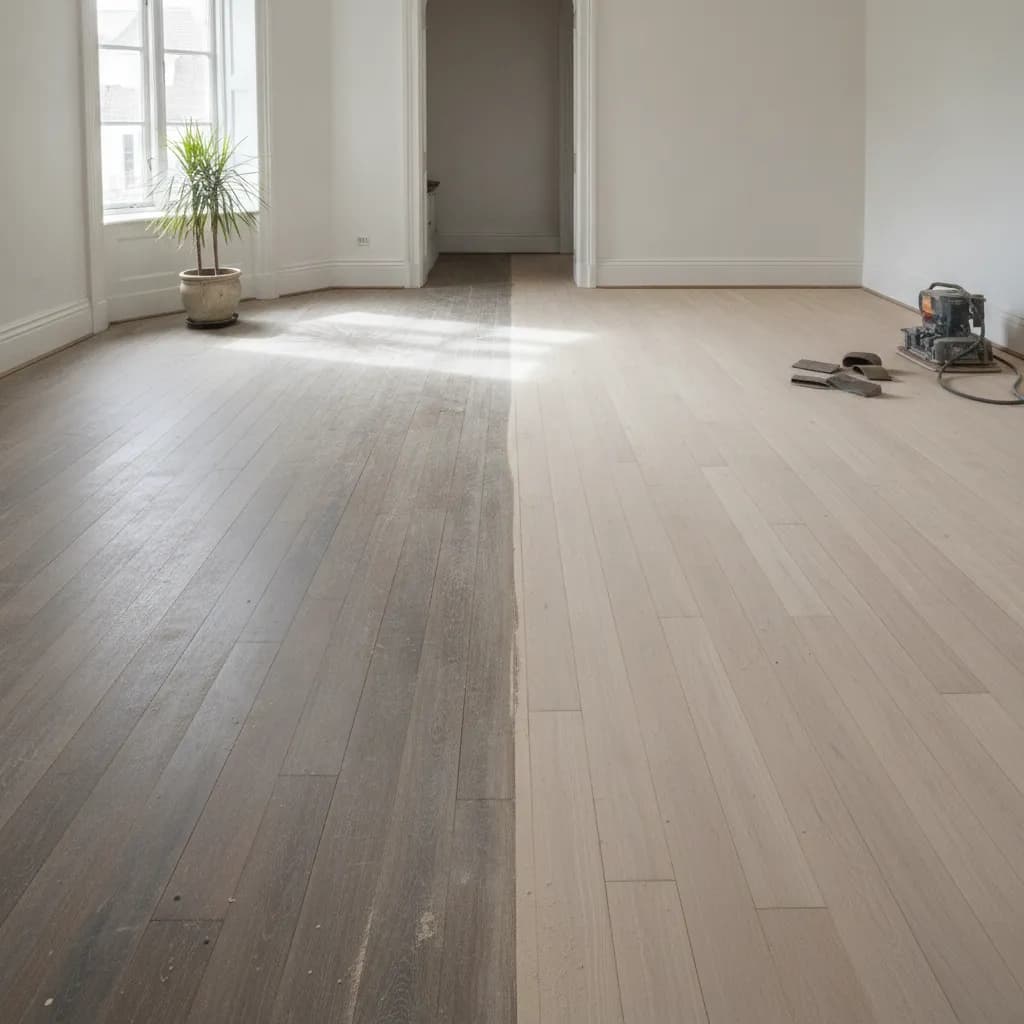
Diagnose before deciding, because floors get tired at three different depths. Finish-tired means the protective coating is dull, fine-scratched, or wearing thin, but the wood beneath is untouched — light reflects unevenly, traffic lanes look cloudy, and water still beads where finish remains. Wood-tired means damage has reached the boards themselves: gray or black patches where finish wore through and moisture hit bare oak, deep gouges, sun-bleached zones, stains soaked into grain. Structure-tired means the problem is under or inside the boards — rot, delamination, chronic movement, water-damaged subfloor telegraphing through. Each depth maps to its own remedy tier: finish-tired floors may not even need a full refinish; wood-tired floors are the classic sand-and-refinish case; structure-tired floors are where replacement starts winning arguments.
The Wood Budget Above the Tongue
A refinish spends wood — every full sanding removes a little of the board's thickness, and the spendable portion is only what sits above the tongue-and-groove joint. Solid three-quarter-inch flooring starts life with enough there for several full sandings; a floor on its first or second refinish almost always has margin, while a floor sanded hard several times may be approaching the end of its account. The balance is checkable, not guessable: board thickness is visible at a floor vent, a stair nosing, or a removed transition strip, and any refinisher worth hiring will look before quoting. Engineered floors run the same math against a much smaller number — the veneer thickness — which buys somewhere between zero and two refinishes depending on the product. An engineered floor with a spent veneer is a replacement conversation no matter how the rest of it looks.
The Damaged-Board Share
Individual bad boards don't doom a refinish — they get cut out and replaced with matching stock, the repairs disappearing into the new finish. The decision variable is how many. Weaving in scattered replacements across a floor is routine; replacing large contiguous areas — a whole pet-damaged hallway, a flooded kitchen's worth — starts to cost like new flooring while still delivering old flooring, and somewhere along that curve replacement simply wins. Availability tilts the math too: common red oak strip is easy to match generations later, while a discontinued engineered product or an unusual width may be unmatchable at any price, turning one ruined area into a whole-floor question.
When Replacement Wins Even Over Healthy Wood
Some replacements have nothing to do with condition. If what you want from the room is a different species, a much wider plank, or a tone the existing wood can't reach — red oak's warmth pushed all the way to pale Scandinavian neutrality is a genuine fight, as we've covered in our refinishing guide — then sanding money spent chasing an unreachable look is the real waste. Same for floors whose layout no longer works after a remodel, or heights that fight new adjacent surfaces. Honesty cuts both ways here: wanting a new floor is a perfectly good reason to buy one. It's just a different reason than needing one, and you deserve to know which decision you're making.
When Refinishing Is the Obvious Call
Sound solid wood, surface-level wear, thickness in the bank, damage limited to scattered boards: refinish, and it isn't close. Sanding resets a decade or two of visible history and hands you a fresh choice of stain and sheen on wood that's already bought, installed, and acclimated to your house — a combination new flooring can't offer at any spec. This is also the only scenario where the crossroads isn't really a crossroads; floors in this condition get replaced every year by owners who were never told sanding was an option, and that's the industry failure this article exists to prevent.
The Middle Path People Forget
Between doing nothing and full refinishing sits the screen-and-recoat: abrading just the finish surface and applying a fresh topcoat, no bare wood involved. For finish-tired floors caught before wear-through, it restores sheen and protection for a fraction of a refinish's cost and disruption — and done periodically, it can postpone the next full sanding almost indefinitely, stretching the floor's sanding budget across a longer life. Its limits are real: it fixes nothing below the finish, and residues from certain polishes and cleaners can sabotage the new coat's adhesion, which is why a test patch belongs in the process. Think of it as the oil change of hardwood ownership — unglamorous, cheap, and the thing that makes everything else last.
Quick Answers
How do I know how many times my floor has been sanded? Check thickness at a vent or transition against the original three-quarter inch, and look for telltales like fastener heads sitting close to the surface — a pro reads this in minutes. Can just one room be refinished? Yes, with the honest caveat that a fresh room beside a worn one shows the contrast, and stain-matching aged adjacent floors is craft, not certainty. Is patched-and-refinished as good as new? Structurally yes; visually, new boards start their aging clock at zero and blend over a season or two of light exposure. What about squeaks and gaps? A refinish changes the surface, not the structure — fixes for movement happen alongside a refinish, not through it.
If your hardwood is at the crossroads anywhere in the Treasure Valley, Alderwood Flooring does both the sanding and the replacing — which means our answer can afford to be the true one. Free estimates.
Sources
National Wood Flooring Association — sand-and-finish standards and guidance: https://nwfa.org/technical-standards/
NWFA consumer resources — refinishing and maintaining wood floors: https://woodfloors.org/


Ready for Floors You'll Love?
Ready to talk through your project? Free estimates throughout The Treasure Valley & Boise Metro.