Materials
Engineered vs. Solid Hardwood in Idaho: Picking a Format
Both are real wood on top — the difference is everything underneath. How construction, subfloor, and refinishing math decide the format question for Treasure Valley homes.
Materials · 7 min read
Once a Treasure Valley homeowner decides they want real wood floors, the next fork in the road isn't species or color — it's format. Solid hardwood is one piece of lumber, top to bottom. Engineered hardwood is a layer of that same lumber bonded over a manufactured core. Walk across the two in a finished room and your feet and eyes will struggle to tell them apart; live with them for twenty years, or try to install them in the wrong place, and the differences run the show. This is the format decision on its own terms: what each construction actually is, where each one is allowed to go, and how to choose for a specific Idaho house rather than from a generic pros-and-cons list.
Same Face, Different Bones
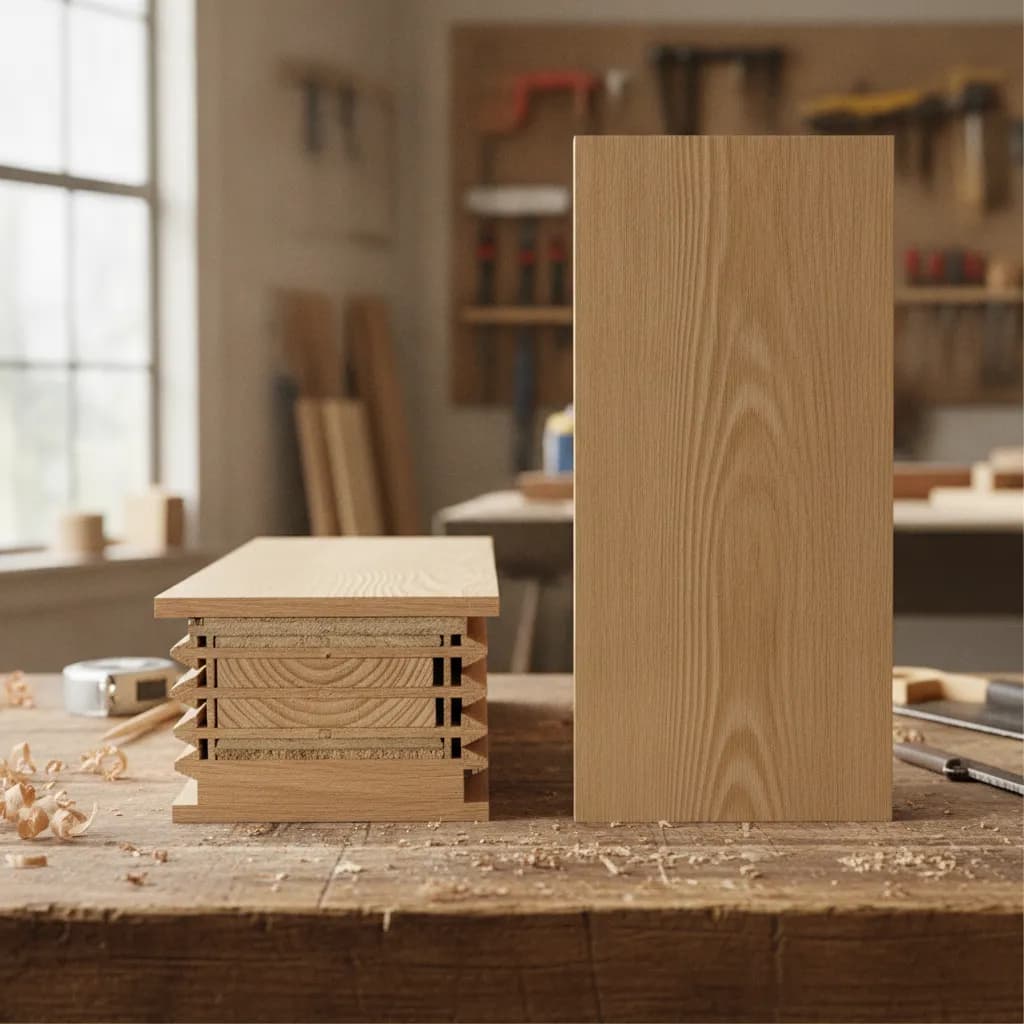
A solid plank is exactly what the name says — three-quarters of an inch of oak, hickory, or maple, milled with a tongue and groove, its entire thickness one continuous piece of wood. An engineered plank puts a genuine hardwood wear layer — the part you see and walk on — over a core of thin wood plies stacked with their grain directions alternating, the same structural idea as plywood. The face of a quality engineered floor is the identical material to the face of a solid floor: same species options, same stains, same finishes, same grain. Nothing about engineered construction is imitation; it's a different way of supporting real wood, invented to solve real problems solid lumber has in certain settings.
What the Core Actually Changes
Wood moves across its width as indoor humidity changes — the mechanism every Idaho hardwood owner eventually learns, and one we've covered in depth elsewhere. The engineered core's alternating plies brace against that width-wise movement, so an engineered plank responds to a dry Boise January with a fraction of the dimensional change of a solid plank of the same face. That stability is the whole reason the format exists, and it pays off most exactly where our climate and construction habits demand it: over concrete slabs, in wide plank formats, over radiant heat, and in any home where winter humidity won't be managed attentively. It also changes what's underneath the surface in a less flattering way — where a solid board has three-quarters of an inch of wood, an engineered board has only its wear layer above the core, and that number varies enormously between products. More on why that matters in a moment.
Where Each Format Is Allowed to Live
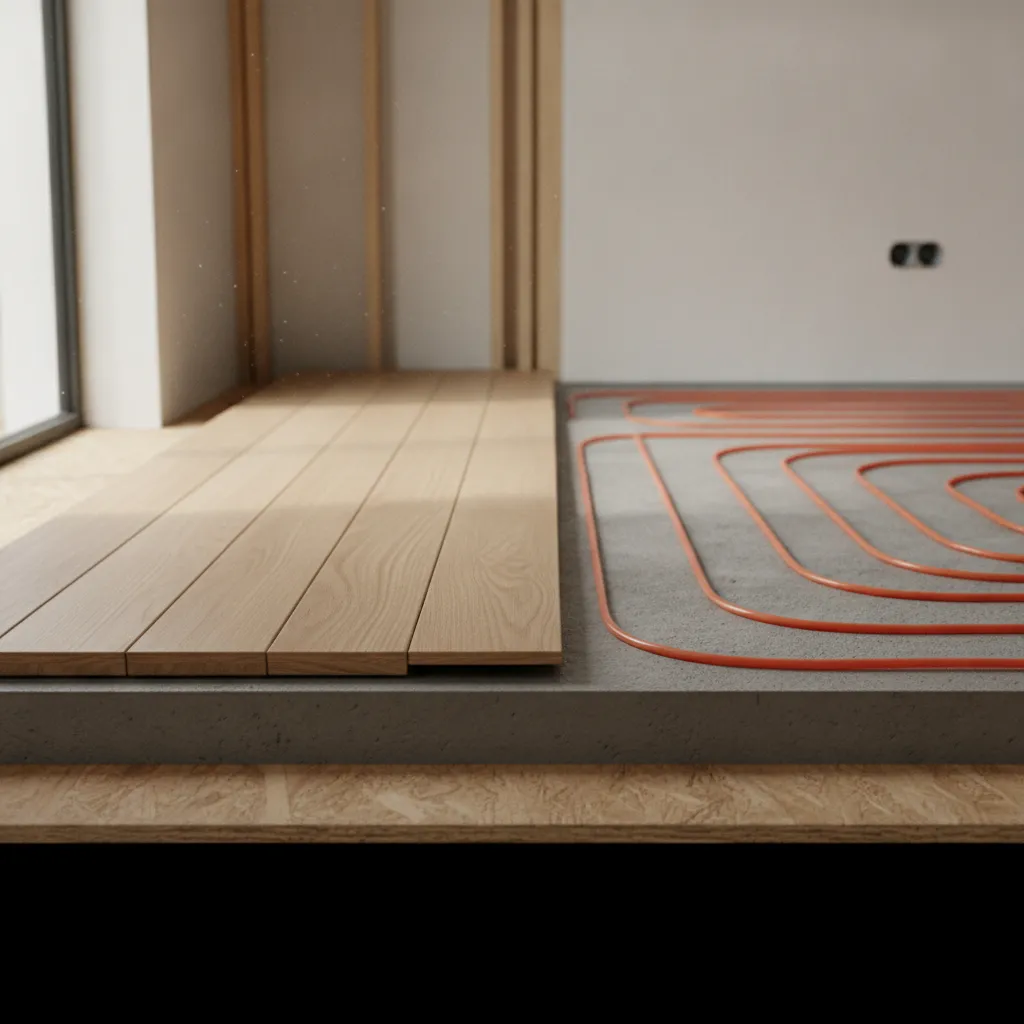
This is the part of the decision that's often not a preference at all. Solid hardwood wants to be nailed to a wooden subfloor, above grade — which describes older Boise and Bench homes over crawlspaces perfectly, and describes almost none of the slab-on-grade construction that dominates the valley's newer neighborhoods. Installing solid wood directly over concrete ranges from inadvisable to impossible depending on method, and most manufacturers simply won't warrant it below grade at all. Engineered hardwood, by contrast, was born for those settings: it can be glued or floated over a tested slab, installed in basements, and — when the specific product is rated for it — run over radiant heat. If your house has a concrete slab, the format question is usually already answered, and no amount of preferring solid changes what's under your feet.
The Longevity Ledger
Solid hardwood's great advantage is its depth of renewable material. With wood above the tongue sufficient for multiple full sandings over its life, a solid floor installed this year can plausibly be refinished by the grandchildren of the people who chose it. Engineered floors span a huge range on this exact axis, and it's the spec that separates the keepers from the disposables: a generous wear layer supports at least one or two genuine refinishes, while the thinnest veneers — some barely thicker than a heavy coat of paint — can never be sanded at all. A thin-veneer engineered floor is, functionally, a one-lifetime product wearing real wood's reputation; a thick-veneer one is a legitimate multi-decade floor. Ask for the wear-layer measurement in millimeters before you fall in love, and treat a salesperson who can't produce it as a signal.
Practical Differences You'll Meet at Install Time
Solid goes down nail-by-nail over wood subfloors, arrives unfinished or prefinished, and — because it's site-sandable — can be installed unfinished and finished in place for a seamless custom look. Engineered installs faster in most settings, tolerates glue-down and floating methods, and its factory finishes are often extremely durable. Height matters more than people expect: three-quarter-inch solid can create transition and door-clearance puzzles in remodels where thinner engineered slips in cleanly. Repairability tilts the other way — board-level repairs and full resands give solid a longer toolbox when life happens to a floor.
How We'd Decide for a Specific House
An older home over a crawlspace with the original plank or plywood subfloor, owners planning to stay indefinitely, a whole-home humidifier in the plan: solid hardwood is playing its home game, and it's hard to argue against. A newer slab-on-grade home anywhere from Nampa to east Boise: engineered, and the decision is really about veneer thickness and core quality. Wide planks anywhere in this climate: engineered, as we've argued elsewhere. Radiant heat: engineered, rated for it. A rental or a shorter horizon: engineered, sized to the realistic timeline. And if two products fit, we'd take the better-built engineered floor over the cheaper solid one — format is a means, and construction quality is the end.
Quick Answers
Is engineered hardwood fake wood? No — the surface is genuine hardwood; the core is genuine wood too, just arranged for stability. Laminate, which prints a photograph of wood on a fiberboard core, is the product that comparison is reaching for. Does solid always add more resale value? Buyers respond to real wood in good condition; almost none of them can identify the format underfoot, and appraisers don't carry moisture meters. Can engineered handle Idaho's dry winters better than solid? Its dimensional stability handles the humidity swing more gracefully, yes — though a well-acclimated solid floor with managed humidity remains a proven Idaho performer. How thin is too thin on a wear layer? If it can't survive at least one real sanding, you're buying a floor with no second act — fine if you know it, disappointing if you don't.
Alderwood Flooring installs both formats across the Treasure Valley and will tell you plainly which one your subfloor, climate habits, and timeline are actually asking for. Free estimates, format honesty included.
Sources
National Wood Flooring Association — technical standards and installation guidance: https://nwfa.org/technical-standards/
NWFA consumer resources — real wood flooring formats: https://woodfloors.org/
USDA Forest Products Laboratory, Wood Handbook — wood movement and dimensional stability: https://research.fs.usda.gov/treesearch/37440
Explore related

Ready for Floors You'll Love?
Ready to talk through your project? Free estimates throughout The Treasure Valley & Boise Metro.