Homeowner Tips
Refinishing Oak Floors in Older Boise Homes
Under the carpet of a lot of Bench and North End homes is original oak waiting for a second life. What sanding actually reveals, what it fixes, and what it honestly can't.
Homeowner Tips · 7 min read
Boise's older neighborhoods are quietly full of real oak. North End bungalows and their early-century neighbors often hide original strip flooring under generations of carpet; Bench homes from the mid-century decades were routinely floored in oak strip before wall-to-wall carpet became the default; and plenty of homes from the 1970s through the '90s in southeast Boise and beyond carry oak that's now overdue for its first or second refinish. If you've just pulled back a carpet corner and found wood, or your existing oak has gone dull and scratched, refinishing is usually the highest-value flooring work an older Boise home can have done. Here's what the process actually involves — including the parts a tidy before-and-after photo doesn't show.
First, What's Actually Under There
Most of what turns up in these homes is red oak strip flooring, commonly in narrow boards around two and a quarter inches wide, nailed over a plank or plywood subfloor. Red oak's strong grain and warm undertone define the look people picture when they think of a refinished older home. Some houses have white oak — slightly denser, cooler and browner in tone — and the two take stain differently, which matters if you're chasing a specific color. Age is not the problem people assume it is: oak that's eighty years old sands and finishes as well as oak from the '90s, provided enough board thickness remains. What matters is how many times it's been sanded before and how it was treated in between.
What Sanding Reveals — the Good and the Bad
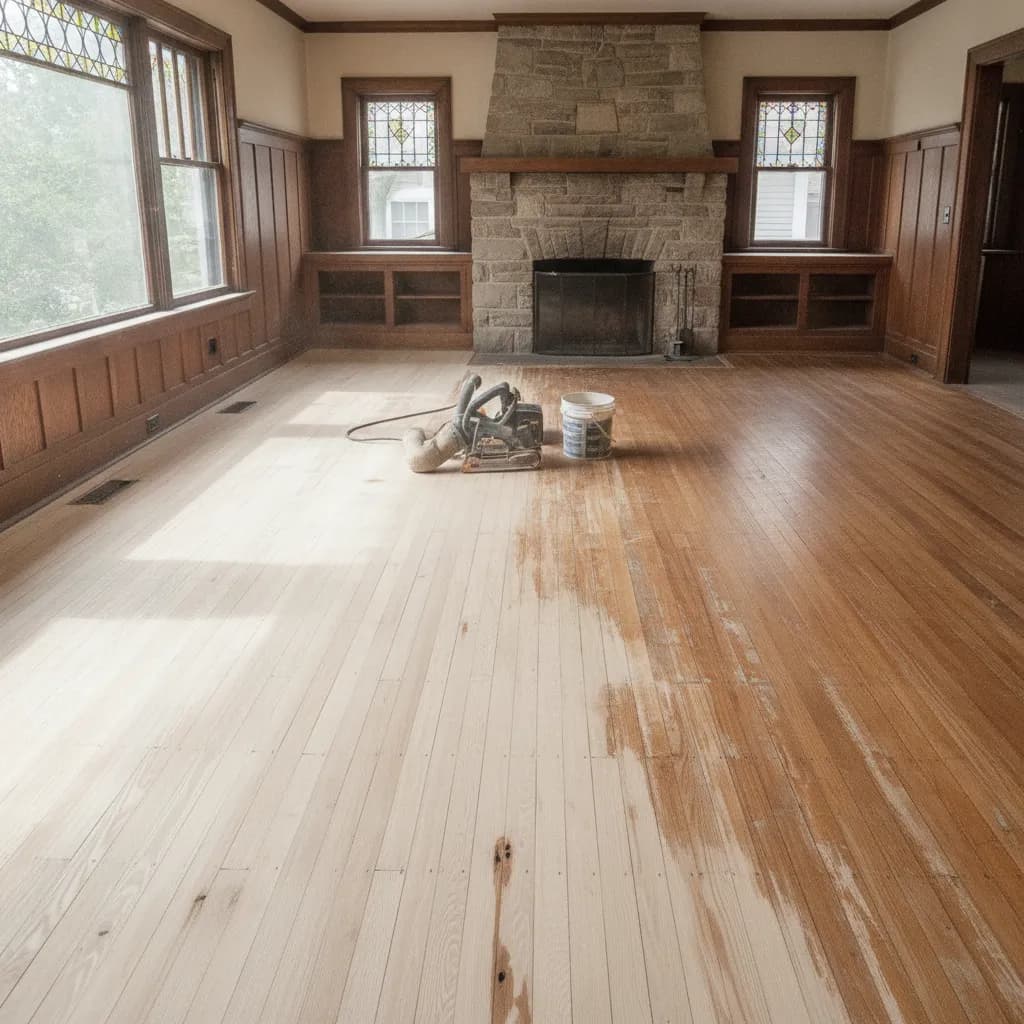
A full refinish sands through the old finish and a thin layer of wood, and it is honest to a fault: everything the carpet hid becomes visible before it becomes beautiful. The good news is how much a sand erases — decades of scratches, dullness, sun fade, most surface stains, and the orange-amber cast of aged varnish all go away with the old surface, and the floor that emerges is genuinely new wood.
The honest list of what sanding does not fix: deep pet stains that have soaked black into the grain often won't sand out — they can be lightened, hidden under darker stain, or cut out and patched with matching boards, but anyone who promises they'll simply disappear is guessing. Gaps between boards are a climate feature, not a finish problem; in our dry winters, older strip floors breathe, and refinishing doesn't close them (fillers in moving gaps tend to crack back out, so we're conservative about promising them). Deep gouges, burns, and water-damaged boards need patching, not sanding. And carpet-era artifacts — tack-strip nail holes along every wall, staple peppering from pad, the occasional painted border where someone framed a rug — get addressed board by board, and small honest scars often remain. Most owners of older homes come to like them.
The Refinish-Count Question
Solid strip oak can be refinished several times over its life, but not infinitely: each full sand removes wood, and the limit arrives when the board surface approaches the nail tongues below. A floor on its first or second refinish has plenty of margin. A floor that's been sanded aggressively multiple times may be near its last — a flooring professional can gauge remaining thickness at a floor vent or transition before anyone commits. If a previous refinisher left deep drum-sander marks or dished-out soft spots, factor that in too. When a floor truly has no sand left in it, the honest options are a screen-and-recoat (renewing the finish without cutting wood) or replacement.
Stain, Finish, and the Look You're Actually Choosing
Refinishing is the one moment you get to redecide the floor's color for the next decade or two. Red oak's pink undertone pushes back against ultra-pale "Scandinavian" looks; it takes mid-browns and darker stains handsomely, and a clear finish gives the classic warm traditional look these houses wore originally. Modern water-based finishes stay clearer and lower-odor and keep the wood's natural tone; oil-modified finishes amber warmly over time and read more traditional. Sheen matters more than people expect — satin and matte hide the daily life of a floor far better than gloss. In a dry-winter climate, a finish is also your floor's moisture jacket, so a properly applied system matters beyond looks; the National Wood Flooring Association's technical guidance is the industry reference for how these systems should go down.
Living Through It
A candid word on logistics: refinishing is disruptive for a few days. Modern dust-containment sanding has genuinely transformed the mess — it captures the overwhelming majority of dust at the machine — but "dustless" is marketing shorthand, not a literal promise. Furniture leaves the rooms, finishes need cure time before furniture and rugs return, and the household routes around the work. It is dramatically less disruptive than replacement, and the result is a floor no new product can quite duplicate: the original wood of the house, renewed.
If you suspect there's oak under your carpet, or your floors have gone tired, Alderwood Flooring will take an honest look — including telling you if a floor doesn't have another sand left in it. Free estimates across Boise and the Treasure Valley.
Sources
National Wood Flooring Association — technical standards for sanding, finishing, and installation: https://nwfa.org/technical-standards/
NWFA consumer resources — refinishing real wood floors: https://woodfloors.org/
USDA Forest Products Laboratory, Wood Handbook — oak properties and wood-moisture relations: https://research.fs.usda.gov/treesearch/37440

Ready for Floors You'll Love?
Ready to talk through your project? Free estimates throughout The Treasure Valley & Boise Metro.