Homeowner Tips
How Long Does Flooring Acclimation Really Take?
Three days? Two weeks? The honest answer is that acclimation ends at a measurement, not a date — here's the schedule question answered the way installers actually work it.
Homeowner Tips · 6 min read
It's the most common scheduling question in wood flooring, and it sounds like it should have a numeric answer: how many days does the flooring need to sit in the house before installation? Ask around and you'll collect confident numbers — seventy-two hours is the folk favorite — but the real answer is that acclimation isn't a duration at all. It's a condition, verified with a moisture meter, and the calendar time it takes to reach that condition varies from a couple of days to several weeks depending on the product, the season, and how far from home the wood starts. Here's the schedule question, answered the way the work actually gets done.
Where the Three-Day Folklore Comes From
Flooring cartons and generic instruction sheets often suggest a minimum acclimation period, and somewhere along the way a common minimum hardened into a universal rule. The problem is that a fixed number of days measures the wrong thing. Wood doesn't know about calendars; it exchanges moisture with the air around it at a rate driven by how far out of balance it is. A bundle of flooring that arrives already close to the home's conditions might genuinely be ready in a couple of days. The same product delivered from a cold, damp warehouse into a furnace-dry January house might need two weeks or more — and three days of sitting in the living room would simply produce a floor that finishes its adjustment after installation, as gaps.
The Numbers That Actually End Acclimation
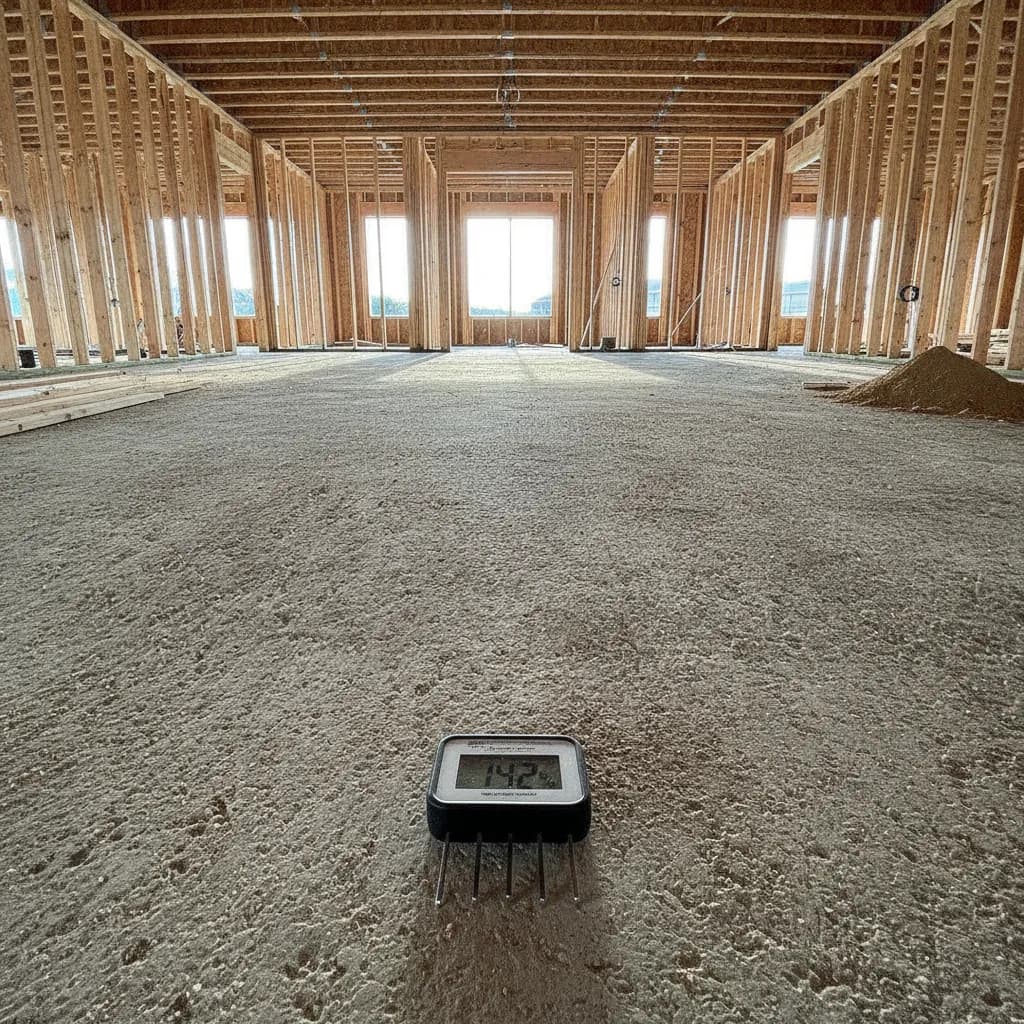
The National Wood Flooring Association's installation guidelines define readiness as a relationship between two measurements: the moisture content of the flooring and the moisture content of the subfloor it's about to marry. For solid strip flooring under three inches wide, the NWFA calls for the two to be within four percentage points of each other; for wider plank, the tolerance tightens to two points, because wide boards punish moisture mismatch harder. Those readings come from a moisture meter in the hands of whoever is responsible for the install — not from a delivery receipt and a wall calendar. When the flooring's readings stabilize in the right relationship with the subfloor, acclimation is over, whether that took three days or seventeen.
The Preconditions That Make the Clock Honest
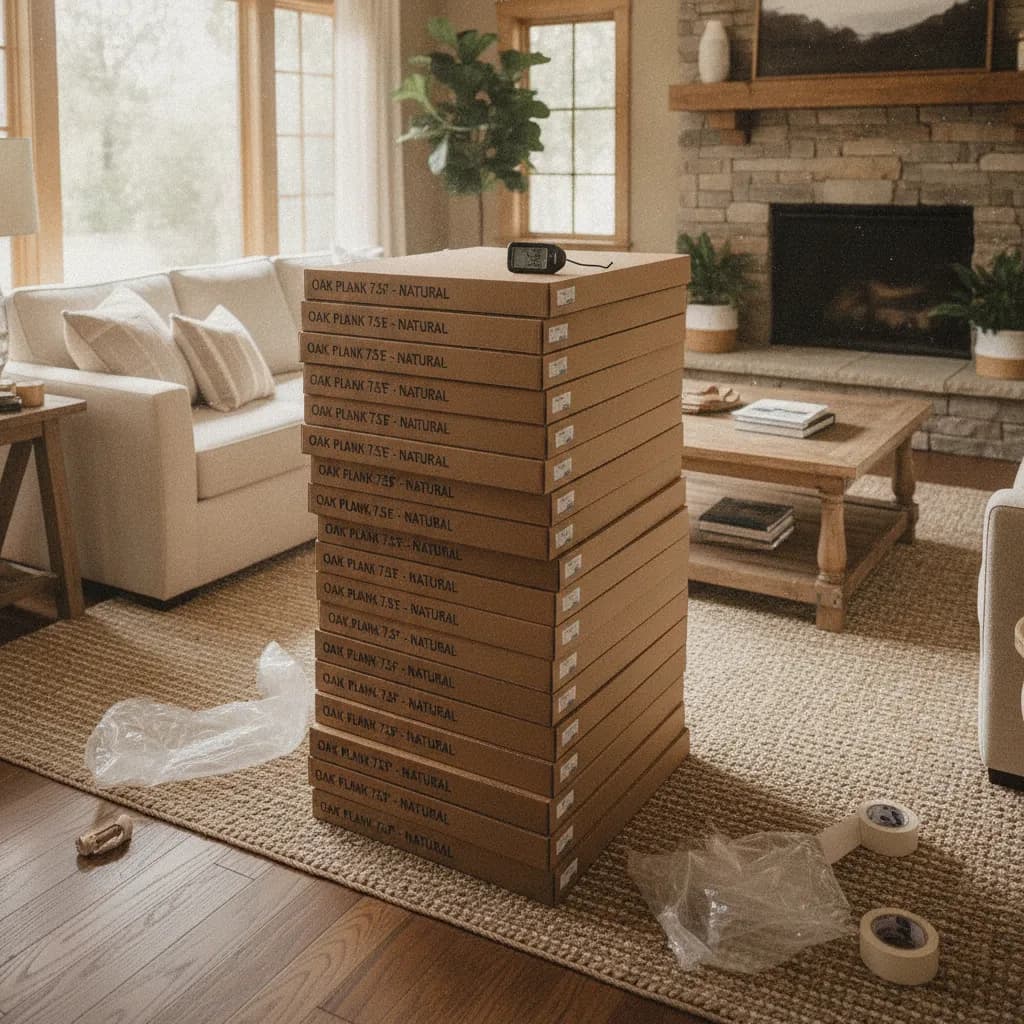
Acclimation counts only when the wood is equalizing to the environment it will actually live in. That means the building is enclosed, the wet trades — drywall mud, texture, paint — are finished and dried out, and the permanent heating and cooling system is running at normal living settings. Flooring stacked in a garage, a job-site trailer, or a house full of drying paint is acclimating to the wrong world, and the days it spends there don't count toward anything except the invoice date. Inside the conditioned space, cartons opened or cross-stacked so air reaches the boards equalize meaningfully faster than a shrink-wrapped pallet, which mostly acclimates its own outer layer.
So How Long, Really?
With the preconditions met: often less than a week for solid flooring that arrives near the target, one to two weeks as a realistic planning window for solid wood in an Idaho winter, and longer for wide plank, for material that started far from equilibrium, or for job sites where the HVAC came online late. Engineered hardwood typically needs less time — its core is dramatically more stable — but quality manufacturers still specify an acclimation period, and the same verify-don't-assume principle applies. The honest scheduling advice: build a flexible window into the plan, deliver the flooring as early as the site allows, and let the meter, not the move-in date, call the install.
Different Materials, Different Rules
Luxury vinyl plank doesn't exchange moisture with the air, so its acclimation is thermal: manufacturers generally want the cartons resting in the conditioned space long enough to reach room temperature — typically a day or two — so planks aren't expanding or contracting from temperature change as they lock together. Laminate splits the difference; its fiberboard core is wood-based and does respond to humidity, so its instructions read more like wood's than vinyl's. Tile needs no acclimation at all, though its setting materials have temperature requirements. In every case, the governing document is the specific manufacturer's instruction sheet — following it is also what keeps the warranty intact.
Quick Answers
Can flooring acclimate in the garage if it's full inside? No — an unconditioned Idaho garage swings between the exact extremes the wood is supposed to be escaping; count those days as storage, not acclimation. Is it possible to acclimate too long? In a stable, correctly conditioned house, no — wood parked at equilibrium just stays there. The real over-acclimation mistake is equalizing to a temporarily humid new build, which calibrates the wood to conditions that vanish with the first heating season. Who should own the moisture readings? The installer — and an installer who talks about meter readings before install day is showing you their habits. Does prefinished versus unfinished change the timeline? Not meaningfully; the finish slows moisture exchange somewhat, but the target relationship between wood and subfloor is the same.
Alderwood Flooring schedules installs around meter readings, not guesses — if you're planning a wood floor anywhere in the Treasure Valley, we'll tell you what your timeline honestly needs to look like. Free estimates.
Sources
National Wood Flooring Association — installation guidelines and moisture-content standards: https://nwfa.org/technical-standards/
Wagner Meters — wood flooring acclimation guidance: https://www.wagnermeters.com/moisture-meters/wood-info/acclimation/
USDA Forest Products Laboratory, Wood Handbook — equilibrium moisture content: https://research.fs.usda.gov/treesearch/37440
Explore related

Ready for Floors You'll Love?
Ready to talk through your project? Free estimates throughout The Treasure Valley & Boise Metro.