Buying Guide
LVP Wear Layers Explained: What the Mil Number Means
Two vinyl planks can look identical and be a decade apart in lifespan. The wear layer is the spec that decides it — here's how to read the mil number like an installer.
Buying Guide · 6 min read
Put two luxury vinyl planks side by side on a showroom shelf and they can be genuinely indistinguishable — same oak photograph, same texture, same click edges. Fast-forward eight years in a busy Meridian household and one of them still looks new while the other has gone gray and bald in front of the kitchen sink. The difference was never visible from above. It was the wear layer: the clear protective coating that stands between the plank's printed design and everything your household does to it. It's the single most predictive number on a vinyl spec sheet, and it's the one the sales tag is least likely to feature. Here's how to read it.
The Anatomy, Bottom to Top
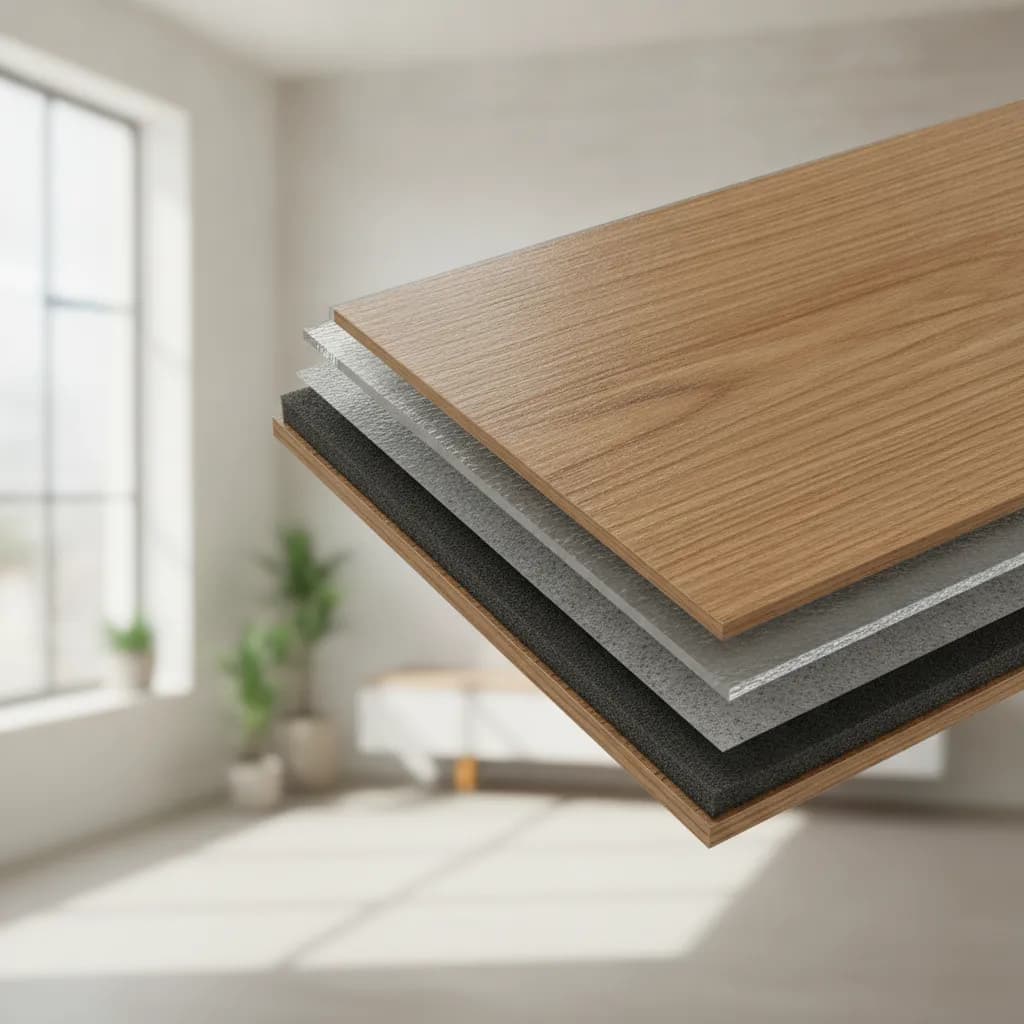
A modern LVP plank is a stack: a core (flexible vinyl or one of the rigid mineral-composite types), a printed design film that provides the wood or stone look, a transparent wear layer over the print, and usually a thin factory-applied performance coating on the very top. Everything you think of as "the floor" — the color, the grain, the plank you picked from forty samples — is that printed film, and it has roughly the durability of a photograph, because that's what it is. The wear layer is the only thing making the picture last. When it abrades away, the print scuffs off with ordinary traffic, and there is no repair for that: vinyl cannot be sanded or refinished, so a worn-through plank is a dead plank.
Mils, Not Millimeters
The wear layer is measured in mils, and the unit trips up almost everyone: a mil is one one-thousandth of an inch, not a millimeter. The confusion is compounded because the plank's overall thickness is usually quoted in actual millimeters — so a spec sheet might describe a five-millimeter plank with a twelve-mil wear layer, two different units doing two different jobs. Overall thickness tells you about rigidity, feel, and how the plank bridges small subfloor flaws. The mil number tells you how long the floor will look like the sample. When someone says a floor is "thick" as a durability claim, the polite follow-up is: which number are we talking about?
The Tiers, Qualitatively
The market sorts itself into rough bands. At the thin end — around six to eight mils — is light-duty material suited to low-traffic rooms, short time horizons, and budget-driven projects; it's also the neighborhood where many production-builder flooring packages live, which is why tract-home vinyl so often shows traffic lanes within a few years while the same neighborhood's upgraded homes don't. The middle band — around twelve mils — is the everyday residential standard, a sensible match for ordinary family life without big dogs or commercial-grade abuse. The heavy band — twenty mils and up — is where busy households, large pets, entries, and rental properties belong; it overlaps the light-commercial ratings, which is a useful mental benchmark: a floor rated to survive a shop or an office shrugs at a family. Beyond that, full commercial products climb higher still, mostly relevant at home only if you want maximum margin. These bands are conventions, not regulations — which is exactly why the number itself, not the marketing tier name, is what belongs in your notes.
What Tract Homes Get, and Why
None of this is a scandal; it's procurement math. A builder flooring a few hundred houses shaves cost where buyers don't look, and nobody tours a model home with a micrometer. The result is that "the house came with LVP" tells you the category and nothing else — the difference between the allowance-grade product and the upgrade tier is largely this one invisible spec. We've written separately about deciding whether builder-grade vinyl is worth keeping; the short version relevant here is that when it retires early, the wear layer is usually what retired.
Coatings, Cores, and Other Distractions
Spec sheets bristle with enhancement language — ceramic-bead coatings, diamond-this, UV-cured that. These finish treatments are real and do improve scratch and scuff resistance, but they ride on top of the wear layer; they are seasoning, not the meal. A heavily marketed coating on a thin wear layer is still a thin wear layer. Similarly, rigid cores improved vinyl's dent resistance and dimensional stability, but core technology does nothing for abrasion. And attached underlayment pads are about sound and feel. Every one of these features has value; none of them substitutes for mils. Certifications are the other spec-sheet line worth respecting — an indoor-air-quality certification like FloorScore tells you the product was emissions-tested, which is a different kind of quality signal the box art also won't mention.
Warranty Fine Print, Translated
Vinyl warranties lean hard on the word lifetime, and the definitions do the real work. Wear-through is typically defined as complete loss of the print layer over a specified area — meaning the ugly, dulled, scratched-up stage you'd actually replace the floor over usually doesn't qualify. Exclusions for grit abrasion, pet claws, improper maintenance, and commercial use carry most of the rest of the weight. Read the warranty as a statement of the manufacturer's confidence tiers rather than as insurance: the products with longer commercial coverage are the ones the maker genuinely built heavier.
Quick Answers
Is a twelve-mil wear layer enough for a big dog? It's the honest minimum for that job, and twenty mils is the comfortable answer — claws plus grit is the exact abrasion the spec exists for. Can you recoat LVP the way you recoat hardwood? Products marketed as renewable-coat vinyl exist at the commercial margins, but for practical residential purposes, no — plan on the wear layer being the floor's whole lifespan. Where do I even find the mil number? On the manufacturer's spec sheet or inside the carton label — and if a retailer can't produce it, that silence is data. Does a thicker plank mean a thicker wear layer? No relationship at all — plenty of chunky eight-millimeter planks carry entry-level wear layers, and some thin glue-down commercial products carry the heaviest ones made.
Shopping vinyl for a Treasure Valley home? Alderwood Flooring quotes LVP with the wear-layer spec written on the line — so you're comparing floors, not photographs. Free estimates.
Sources
Resilient Floor Covering Institute — industry association for resilient flooring in North America: https://rfci.com/
SCS Global Services — FloorScore indoor air quality certification for hard-surface flooring: https://www.scsglobalservices.com/services/floorscore
Explore related
Ready for Floors You'll Love?
Ready to talk through your project? Free estimates throughout The Treasure Valley & Boise Metro.