Developer Guides
Build-to-Rent (BTR) Community Flooring
How to specify flooring for build-to-rent and single-family-rental communities in the Treasure Valley: a for-sale look with rental durability, standardized so future turns and repairs stay consistent across every home.
Developer Guides · 11 min read
Build-to-rent has become one of the fastest-moving segments in the Treasure Valley. Detached rental homes, cottage courts, and horizontal apartments are going up across Meridian, Nampa, Caldwell, Kuna, and the edges of Boise, and they occupy an unusual middle ground. They are built like for-sale product, marketed like for-sale product, and photographed like for-sale product. But they are operated like apartments: leased, lived in hard, turned on a schedule, and maintained by a management team that has to keep dozens or hundreds of units consistent over a long hold. Flooring sits right at the center of that tension, because it is the first finish a prospective renter sees and the finish most likely to determine what a turn costs three years from now.
The mistake we see most often is treating a BTR community like a single custom home repeated fifty times. Custom-home instincts push toward variety, toward the nicest-looking board at a given price, toward whatever the model home merchandiser liked that quarter. Those instincts quietly destroy the economics of a rental portfolio. The right way to think about BTR flooring is as a system: one specification, documented and locked, that delivers a convincing for-sale appearance while surviving rental use, and that can be turned, patched, and reordered years later without anyone guessing. This guide walks through how we approach that system for developers and operators, and the specific decisions that matter in Idaho's high-desert climate.
The stakes are long-term. A for-sale buyer lives with their floor and eventually sells the problem to someone else. A BTR owner holds the asset, absorbs every turn, and pays for every callback. That changes what "good flooring" means, and it changes how a floor should be specified from the first model home forward.
The BTR Floor Has Two Jobs That Pull Against Each Other
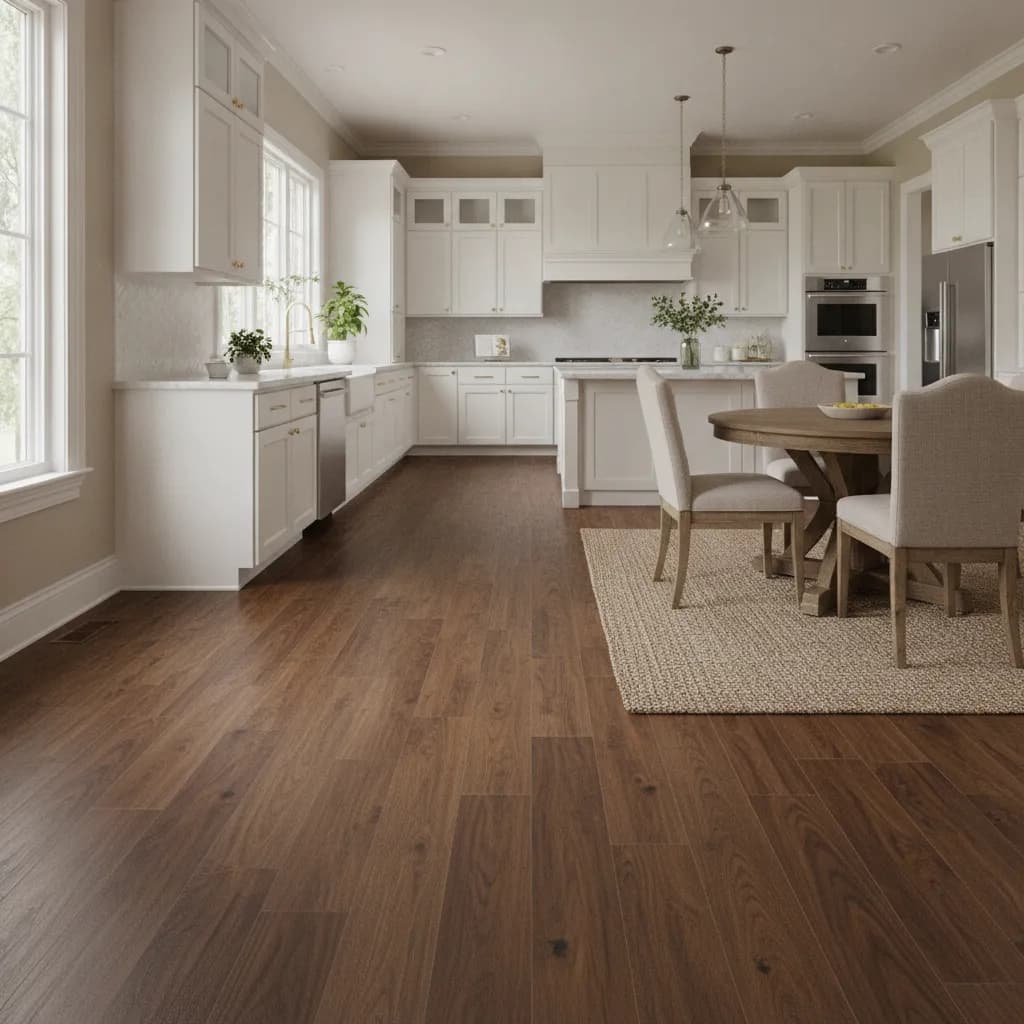
A build-to-rent floor has to lease the home and then survive the tenant. Those are genuinely different requirements. Leasing rewards the look and feel of ownership: wider planks, warmer or more current colors, a matte or low-sheen finish that reads as real wood, and enough visual continuity that a prospect walking the model imagines living there rather than renting a box. Surviving the tenant rewards the opposite instincts: tight, forgiving wear layers, finishes that hide scratches and pet traffic, seams that resist moisture, and a construction that a maintenance tech can repair a single plank of without pulling a whole room.
The good news is that modern rigid-core products, and to a lesser extent engineered wood, let you satisfy both jobs at once far better than the vinyl sheet and builder-grade laminate of a decade ago. The bad news is that "luxury vinyl" and "engineered hardwood" are enormous categories with a 5x range in real-world durability. A wear layer that photographs identically to another can fail in a third of the time. The specification work is where the money is won or lost, and it is invisible in a model-home walkthrough, which is exactly why it gets skipped. For a broader look at product families and how they behave under lease conditions, our page on durable rental flooring covers the wear-layer and construction trade-offs in detail.
Standardize the Spec, Not Just the Product
The single highest-leverage decision in BTR flooring is standardization, and it goes deeper than picking one color. A real BTR standard locks the manufacturer, the exact product line and SKU, the color, the plank dimensions, the wear-layer thickness in mils, the underlayment (attached or separate), the transition and reducer profiles, and the installation method. It documents the moisture-mitigation approach for slab-on-grade homes and the acclimation protocol. It names the trim, the stair treatment, and the threshold details. Then it gets written down and attached to the community, not carried around in one superintendent's head.
Why this depth matters becomes obvious at the first turn. Three years in, a unit needs four planks replaced after a refrigerator leak. If the community was floored with "whatever luxury vinyl was on sale that phase," the maintenance team is now dye-lot matching a discontinued product across a patchy repair, or reflooring an entire room to keep it looking intentional. If the spec is locked and the operator holds attic stock from the same run, the repair is four planks and an hour. Standardization is not an aesthetic preference; it is a maintenance budget decision made years in advance. When we help developers assemble their community package, this documentation is the deliverable, and our multifamily flooring packages approach is built around producing exactly that kind of locked, reorderable specification.
Reading a Wear Layer and What Actually Predicts Turns
For rigid-core LVP, the wear layer is the number that most predicts how a floor holds up under rental traffic, but the raw mil count is only half the story. A 12-mil wear layer with a strong urethane and aluminum-oxide topcoat outperforms a bare 20-mil layer. For BTR detached homes, we generally specify wear layers in the 12-to-20-mil range depending on positioning, with the higher end reserved for pet-heavy and entry-adjacent areas. Below 12 mil starts to show gouging and traffic lanes on a rental turn cycle, and the savings do not survive the first re-sand-or-replace decision.
Beyond the wear layer, look at the core density and the locking system, because those govern how the floor behaves over an imperfect subfloor and how repairable it is. Ask for the manufacturer's abrasion and indentation data rather than marketing tiers, and check the finish's DCOF slip rating against ANSI A326.3 for entries and wet areas. For engineered wood in higher-end BTR product, the veneer thickness determines whether the floor can ever be refinished; anything under roughly 2 mm of wear layer is effectively a one-life floor, which may be perfectly acceptable in a rental if the replacement plan accounts for it. The NWFA's guidelines on engineered wood construction and moisture are the reference we work from when a community wants real wood in its detached homes.
Idaho Moisture: The Slab and the Dry Winter
Two Idaho realities shape every BTR flooring spec here, and both get underestimated by teams used to milder markets. The first is slab moisture. A large share of Treasure Valley BTR homes and horizontal apartments sit on slab-on-grade, and new concrete releases moisture for months. Installing a floor over a slab that has not been tested is the most common cause of adhesive failure, cupping, and telegraphing seams. We test before we specify a bonded system: relative humidity probes per ASTM F2170 and, where relevant, calcium chloride per ASTM F1869. Those numbers drive whether a floated rigid-core assembly, a moisture-mitigating membrane, or a full mitigation coat is required. Skipping the test to hold a schedule is the false economy that shows up as a warranty claim during the first lease-up.
The second reality is the high-desert winter. Boise-area indoor air can drop to single-digit relative humidity when forced-air heat runs against cold, dry outside air. Wood and even some rigid cores lose dimension in that environment, opening gaps at seams and end joints. The defenses are chosen at spec time: prefer dimensionally stable rigid-core products for detached rentals, respect the manufacturer's expansion-gap and acclimation requirements to the letter, and — for communities that insist on real engineered wood — plan for whole-home humidification and set tenant humidity expectations in the lease materials. A floor that looks flawless at January handover and gaps by the next January was not a bad product; it was a floor specified without the Idaho winter in mind.
Entries, Radiant Heat, and the Details That Fail First
BTR communities in this climate live and die at their thresholds. Snow, gravel, sand from winter road treatment, and mud from unfinished landscaping in a new phase all get dragged across the entry every day. We specify the toughest wear layer and the best slip resistance at entries and mudrooms, detail durable transitions at every door, and often recommend a designed walk-off zone rather than leaving it to whatever mat a tenant buys. This is not glamorous, but it is where the first traffic-lane wear and the first callback almost always appear.
Radiant floor heat is increasingly common in higher-end Treasure Valley product, and it constrains the flooring choice. Not every rigid-core or engineered product is rated over radiant systems, and those that are carry maximum surface-temperature limits, ramp-up protocols, and specific underlayment rules. We confirm compatibility against the manufacturer's radiant documentation before anything is specified, because a floor that voids its warranty over hydronic heat is a liability disguised as a finish. The same discipline applies to stair treatments, which are a heavy-wear, life-safety detail in two-story detached rentals and deserve a purpose-made tread and nosing, not a field-cut plank.
Indoor Air Quality and Emissions at Scale
At community scale, the flooring product is one of the largest interior material purchases in the project, and its emissions matter — for tenant health, for lease-up in a market where renters increasingly ask, and for any green-building or financing requirement the developer is working under. Composite cores and the adhesives around them are the relevant sources. We specify products that meet CARB Phase 2 formaldehyde limits and carry recognized low-emission certification such as FloorScore under the SCS Global and RFCI program, and we keep that documentation with the community submittal package. It costs nothing extra to specify certified product from the start and it removes a category of risk entirely; retrofitting a healthier floor after a community is built is not a real option.
Sequencing Flooring Across a Phased BTR Build
BTR communities deliver in phases over months or years, and that sequencing is a flooring problem as much as a scheduling one. The product specified in Phase 1's model home has to still be orderable in Phase 4, or the community loses the visual consistency that made it feel like for-sale product in the first place. We manage this by locking the spec early, confirming the manufacturer's runout and discontinuation risk, building in attic-stock quantities from matched dye lots, and coordinating installation windows so slabs have cured and the building is dried-in before floors go down. On the trades side, flooring is one of the last finishes and is easily crushed by an accelerated close-out; protecting the installed floor through the punch and turn-ready cleaning stages is part of the scope, not an afterthought. Developers assembling a full community program will find how we structure this on our developers overview.
Bringing It Together for the Community
The through-line of every decision above is the same: a build-to-rent floor should look like ownership and behave like a rental, and it should be specified once, documented completely, and held consistent across the whole community for the life of the hold. That means a wear layer and construction chosen for turns, not just for the model-home photograph. It means testing the slab and respecting the Idaho winter before anything is bonded or floated. It means locking a SKU, holding matched attic stock, and writing the spec down so a maintenance tech three years from now repairs four planks instead of reflooring a room. Get those decisions right at the front and the flooring quietly does its job for years. Get them wrong and the floor becomes a recurring line item in every turn budget.
Alderwood Flooring works with Treasure Valley developers, BTR operators, apartment owners, and home builders to build exactly this kind of standardized, turn-ready flooring program — capability grounded in 20+ years of combined experience, as an insured Idaho Registered Contractor (Idaho RCE-6681702) standing behind a workmanship warranty. If you are planning a build-to-rent or single-family-rental community and want the flooring specified to lease well and turn cheaply, reach out through our contact form and we will help you put the system together.
Sources & Further Reading
Explore related
Ready for Floors You'll Love?
Ready to talk through your project? Free estimates throughout The Treasure Valley & Boise Metro.